

Wood-Look & Marble-Look Porcelain for Florida Homes
You wanted the teak lanai and the marble pool deck. Florida wanted rot, splinters, etching, and a resealing calendar — so here is how wood-look and marble-look porcelain give you the exact look without any of that, named collection by collection.
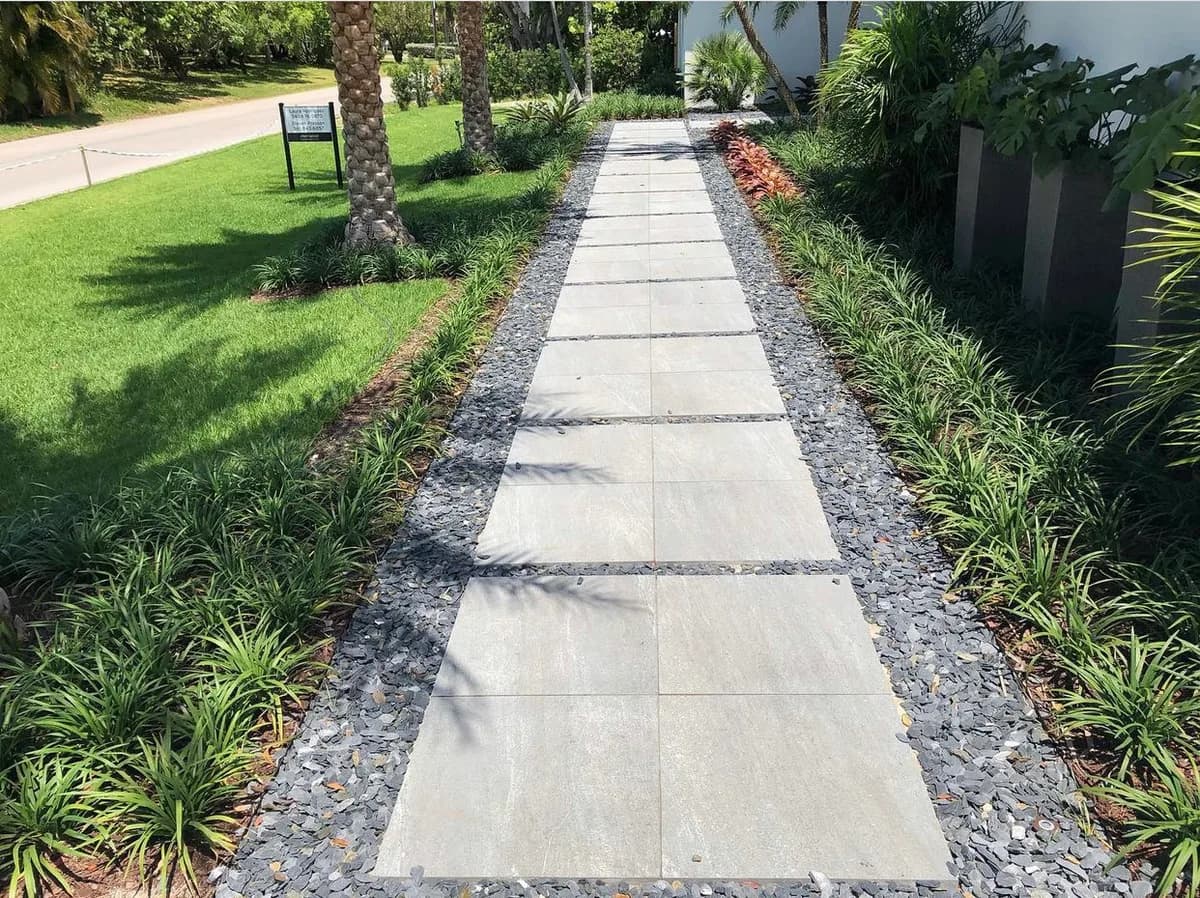
The Look You Fell In Love With, Minus Its Weaknesses
Almost every homeowner arrives with a picture in their head, and it is usually one of two. The first is warm: a wide teak deck off the lanai, grain running long toward the water, the whole space feeling like the deck of a boat at Anna Maria Island. The second is cool and formal: a white marble pool deck with grey veining, bright at eleven in the morning, the kind of surface that makes a screened cage look like a resort. Both pictures are real and both are worth wanting. The problem is that neither material survives being the actual floor of a Florida backyard. Real teak in Manatee County means cupping in ninety percent summer humidity, splinters by year three, and a sanding-and-oiling weekend on the calendar every spring. Real marble at a pool means calcium carbonate sitting in chlorine and salt spray, which is a chemistry problem, not a maintenance one.
So the honest question is not whether you can have the look. It is whether you can get it out of a material that does not mind the conditions. Porcelain pavers do exactly that, and the reason is manufacturing rather than marketing. The pattern is applied by high-resolution digital printing, then the body is pressed and fired past 2,200 degrees until it vitrifies — the clay effectively turns to glass, closing its pores down under 0.5 percent water absorption. Color runs through the body rather than sitting in a coating on top, and the pigments are inorganic and UV-stable, which is why a paver installed in 2019 still matches the sample chip in the showroom. Nothing to seal, nothing to oil, nothing to strip. You are buying the appearance of one material and the behavior of a different, much tougher one.
Wood-Look: Teak Warmth for a Lanai That Never Splinters
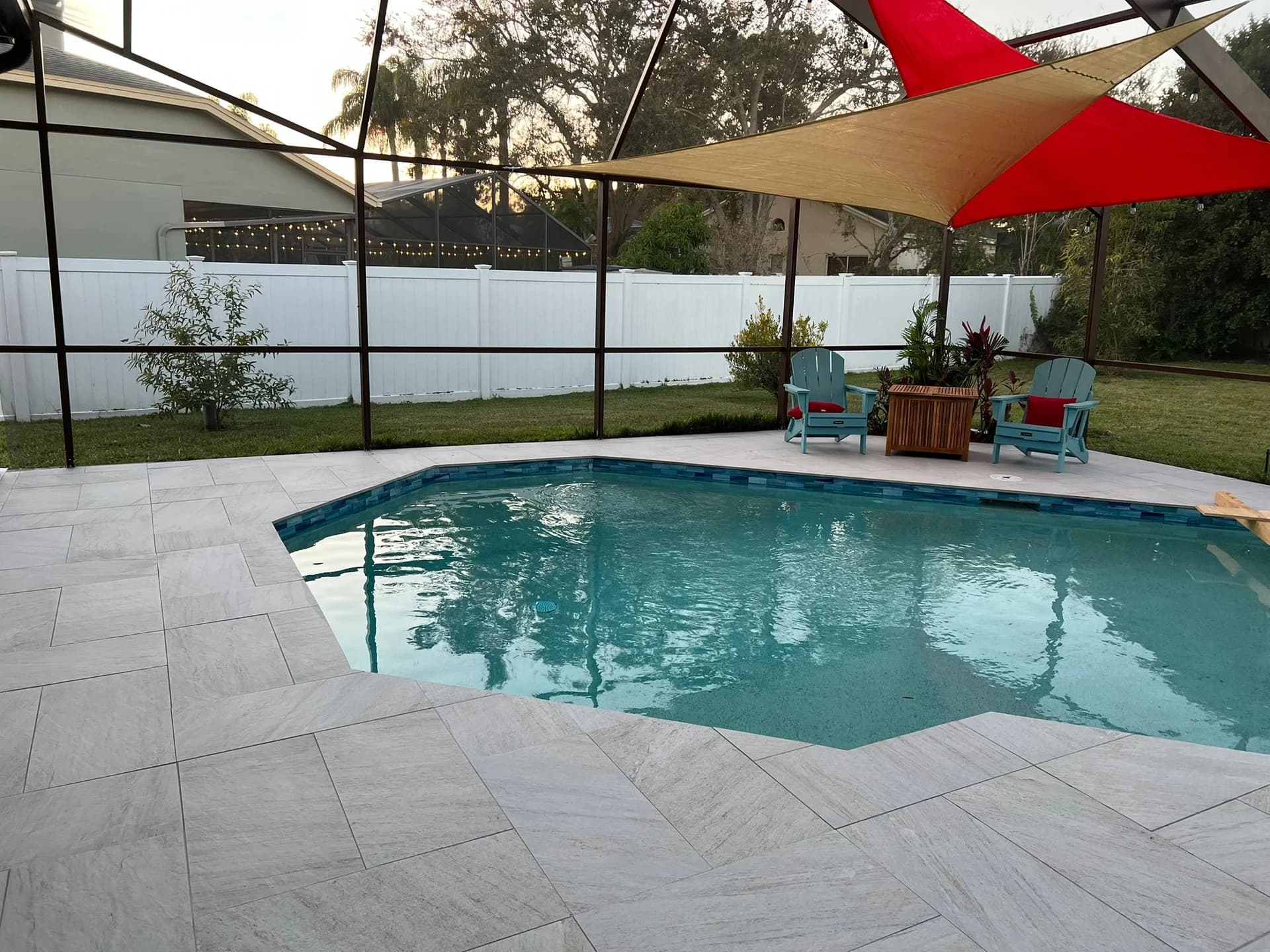
Wood-look porcelain does not come in squares. It comes in planks, typically 8 by 48 or 12 by 48 inches, laid in a running bond so the grain carries the length of the space the way real boards would. Hardscape.com runs this look in its 3CM Cadore Rovere plank paver, a rovere oak read with whites and greys running through it — cooler and more contemporary than the orange-brown you get from stained pine. Belgard offers plank-format porcelain in its outdoor line as well. Where this look genuinely earns its place is the screened lanai and the covered outdoor kitchen: rooms that want warmth underfoot because they function as living rooms, but that sit outside and take the weather anyway. Run the planks parallel to the long axis of a narrow Bradenton lanai and the room reads noticeably longer. Run them perpendicular to a wide slider wall and the space pushes outward instead.
Then the Florida part. Wood-look porcelain cannot rot, cannot splinter under a bare foot, cannot cup or crown when the humidity swings, and does not host the black mildew that colonizes the shaded south side of a wood deck by August. Termites have no interest in fired clay. There is no annual sanding, no oil, no stain, no board replacement — the pressure washer and a broom are the entire maintenance program. The money favors porcelain too: a real wood deck built to current Florida code is expensive to frame and fasten, and part of that cost comes back every few years as boards fail. Wood-look porcelain typically installs for less, and then essentially stops costing money. Cheaper on day one and cheaper again on day four thousand.
Marble-Look and Travertine-Look: The Pool Deck Guests Photograph
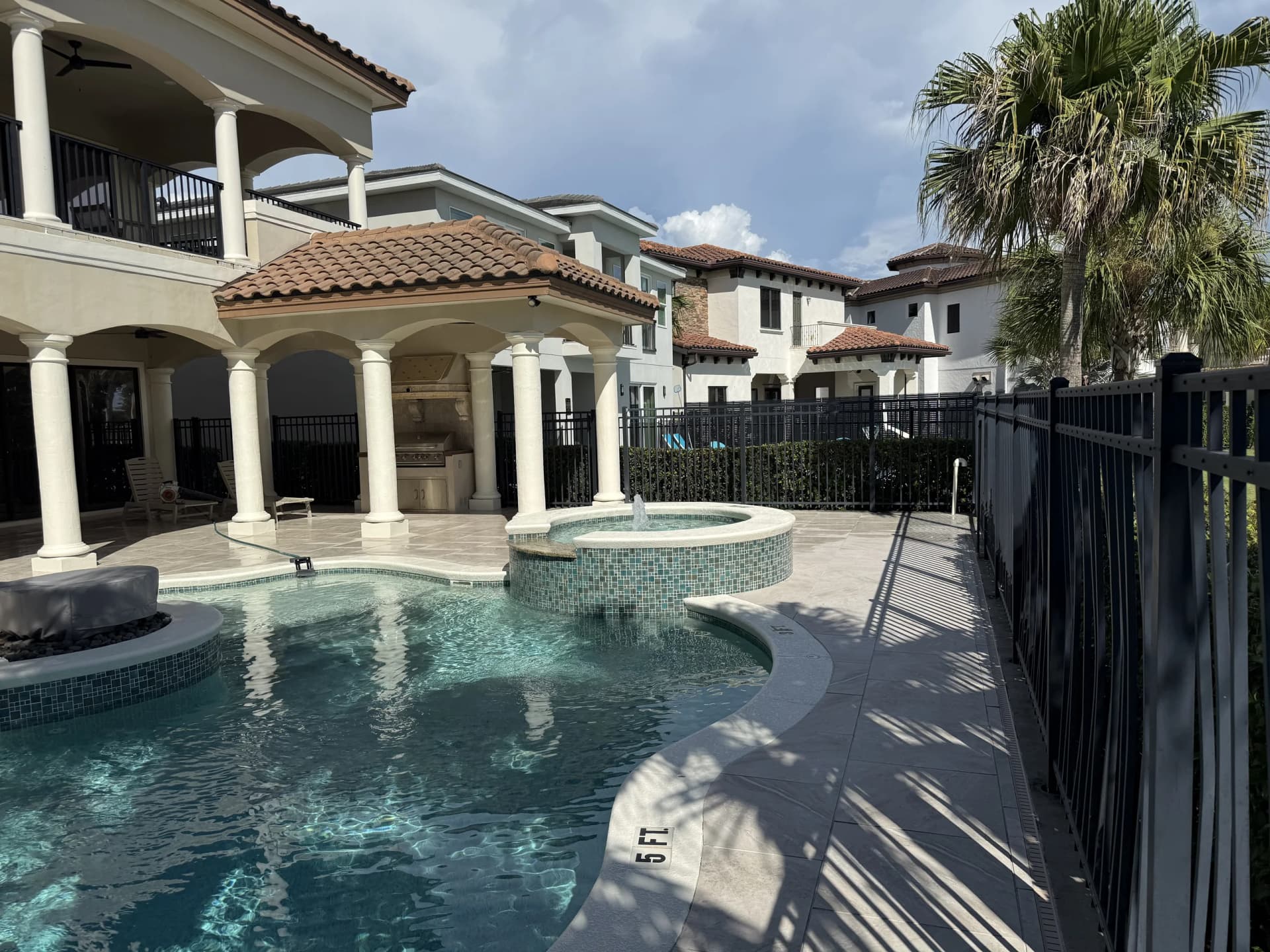
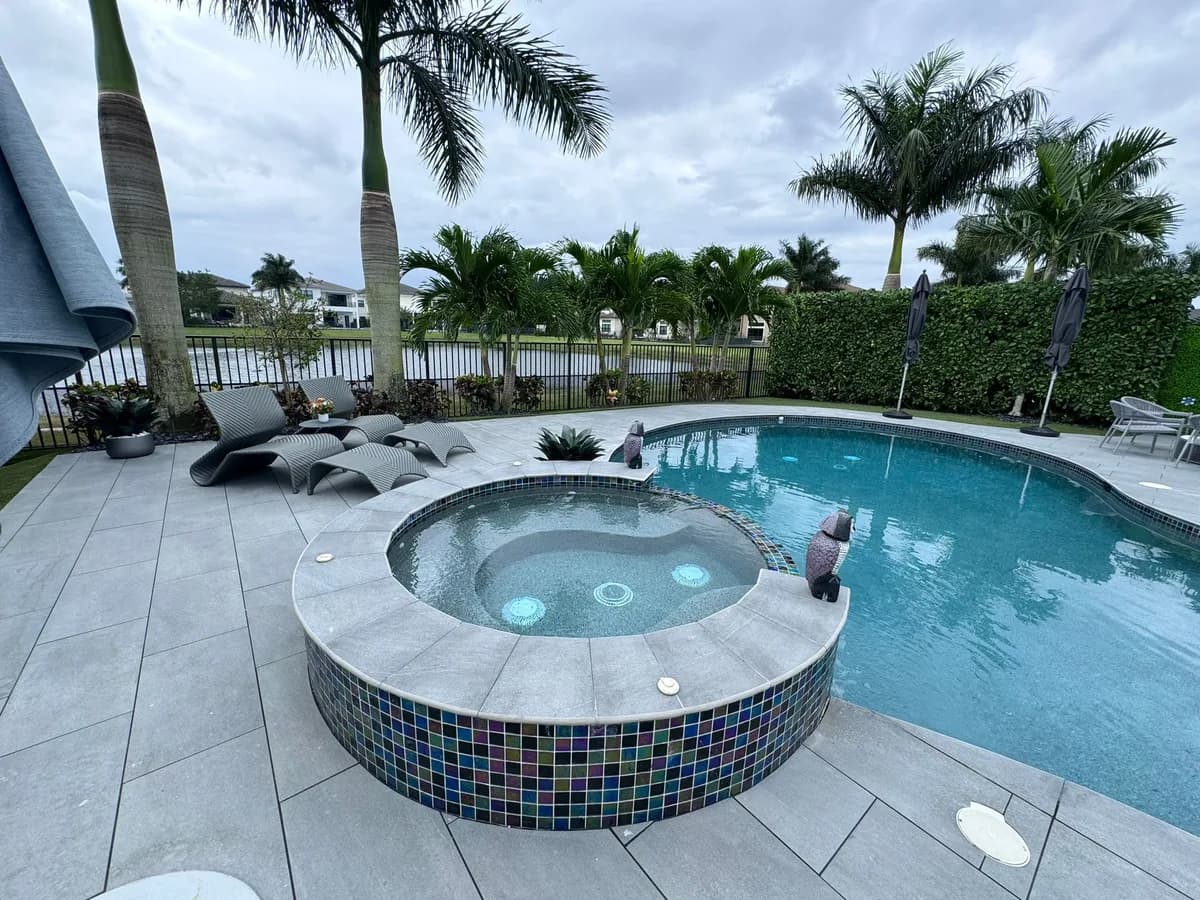
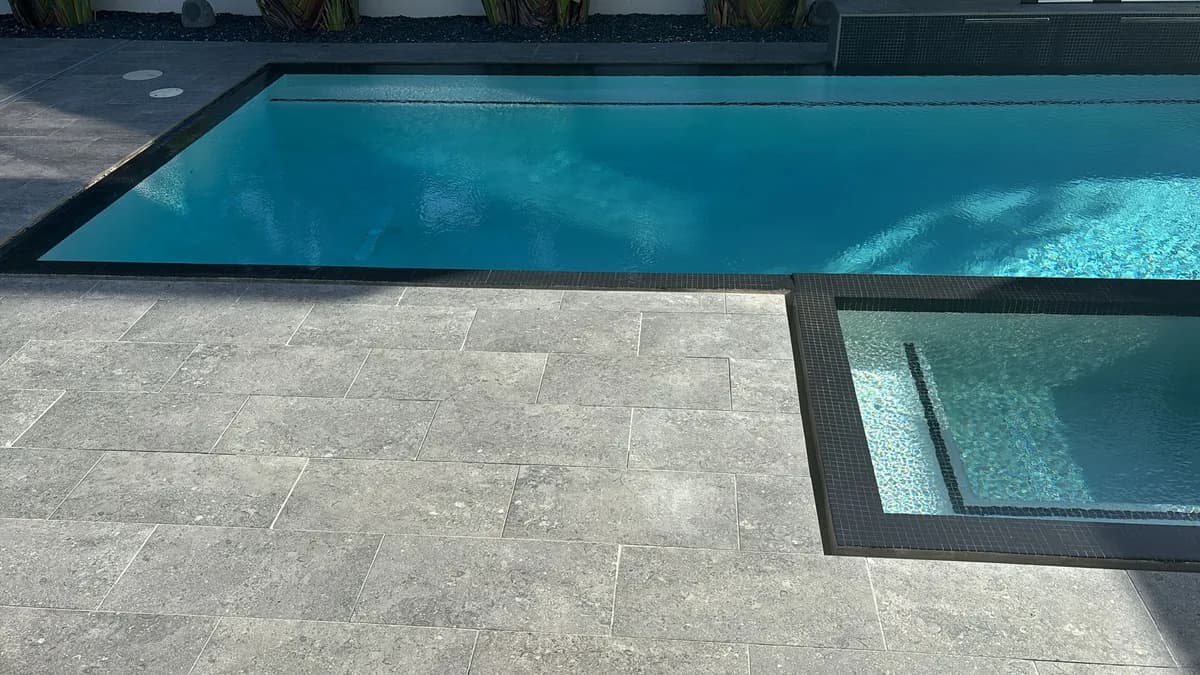
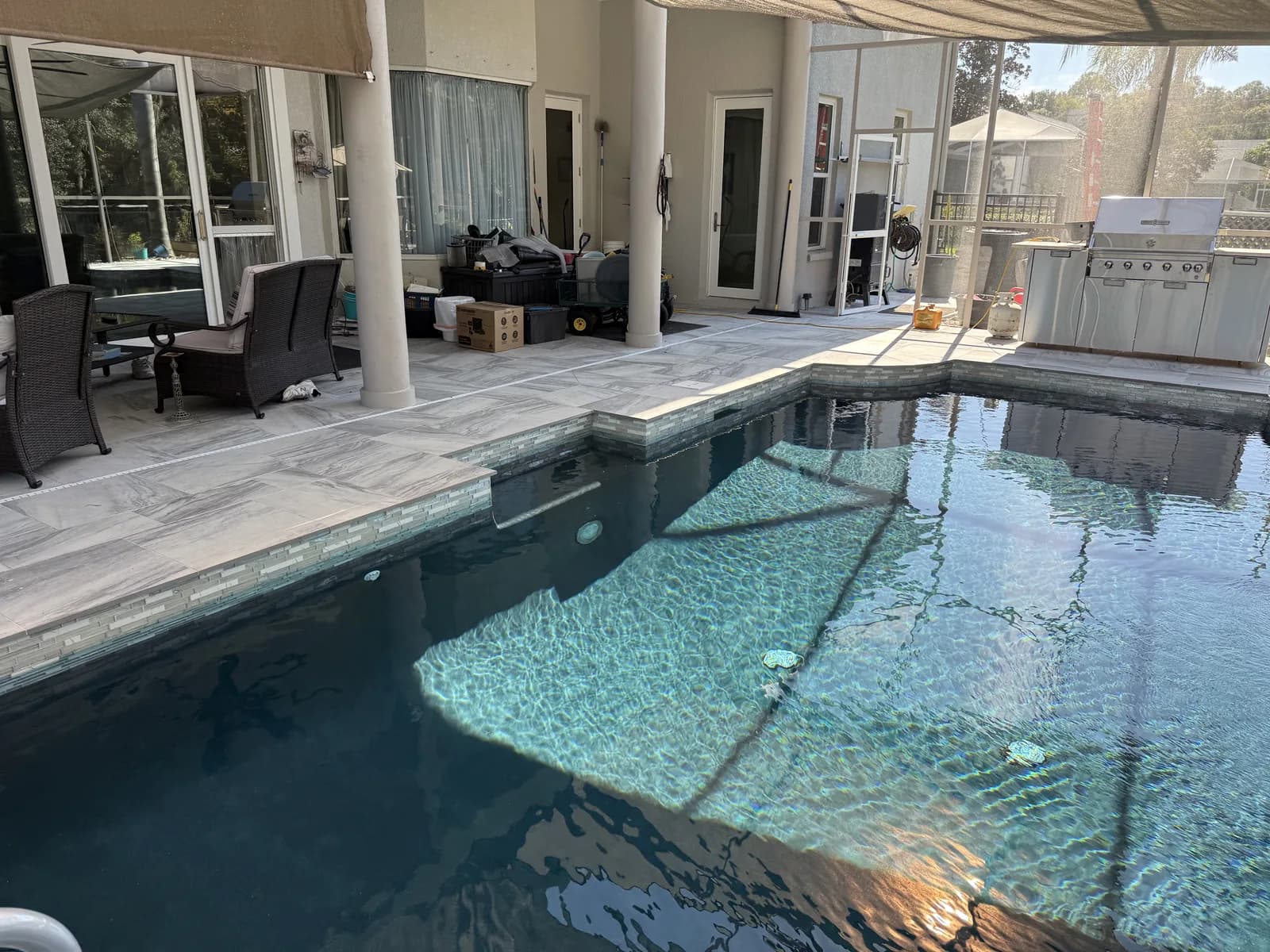
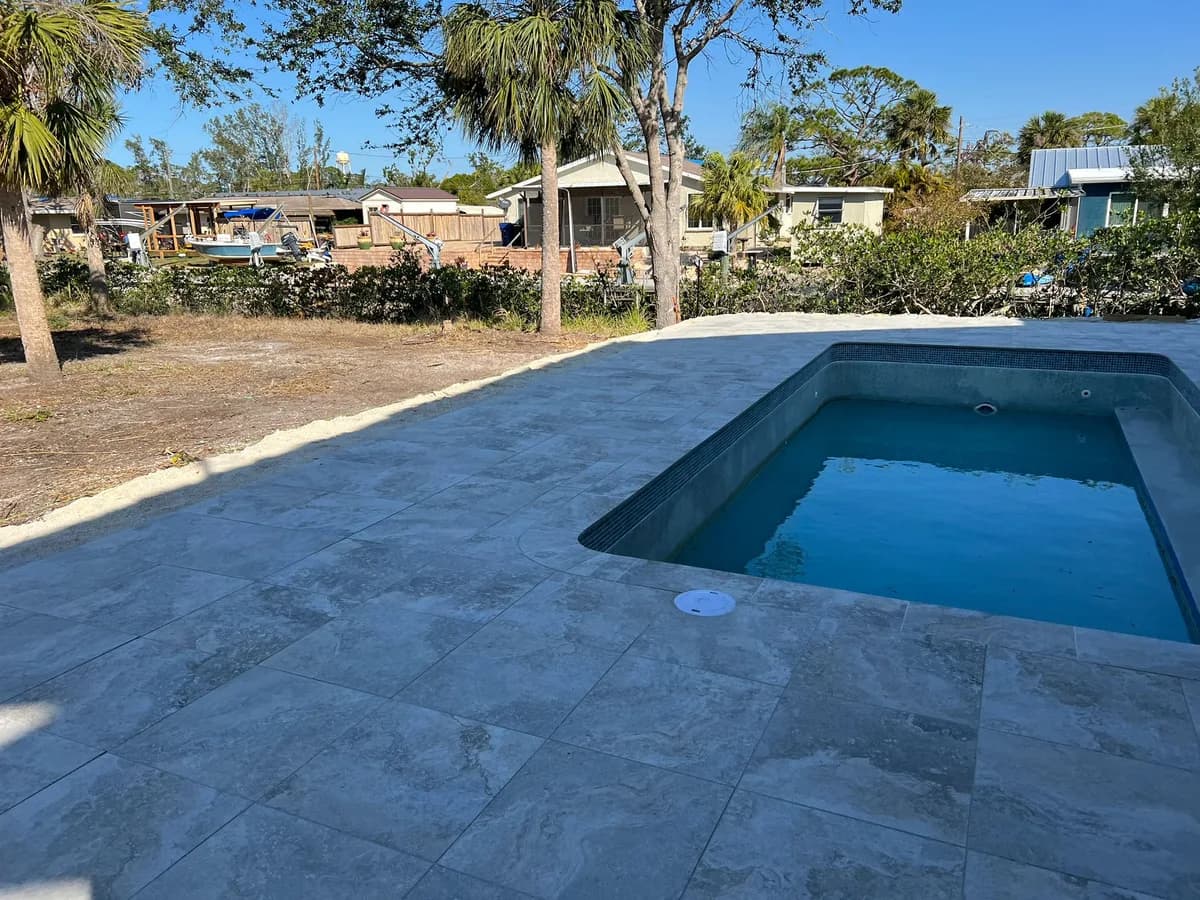
The marble-look side of the catalog is where porcelain stops being a substitute and starts being the better object. Hardscape.com's 2CM Da Vinci is the one people stop walking for: rich browns, greys, and blacks with white veins moving across each paver like the canals it is named for, dramatic enough that a simple rectangular deck needs no other decoration. If you want the brighter, cleaner direction instead, Calacatta gives you the classic white field with grey veining, and it is the one that turns a Lakewood Ranch screen cage into something that photographs like a hotel. Order either in large format — 24 by 24 or larger is the direction 2026 is pointed — and the deck reads bigger because there are simply fewer joint lines interrupting the field. Travertine-look sits beside it in warm neutrals: Roma Travertine from Hardscape.com in greys, golds, creams, and beiges, Coralina Ivory for the coquina-and-shell coastal look, and Belgard's Travertini in 24 by 24 and 24 by 48 with either linear or cross-cut veining.
Every one of those looks is a material that would have failed you in its natural form. Real marble is calcium carbonate, which means chlorinated splash-out and coastal salt etch it, dulling the polish into cloudy patches — and polished marble is slick when wet, which is the wrong property for the four feet of deck nearest the water. Real travertine drinks water through open voids, needs resealing every eighteen to twenty-four months in this climate, and picks up chloride that works on it from the inside. The porcelain versions are non-porous, chemically indifferent to pool water and salt air, and specified with R11 slip-rated textured surfaces for wet zones. Light-toned marble and travertine looks also hold surface temperature far better than a dark deck, which on an unshaded Palmer Ranch pool deck in August is the difference between crossing barefoot and hopping toward the towel.
What the Manufacturers Say vs. What We See in Florida
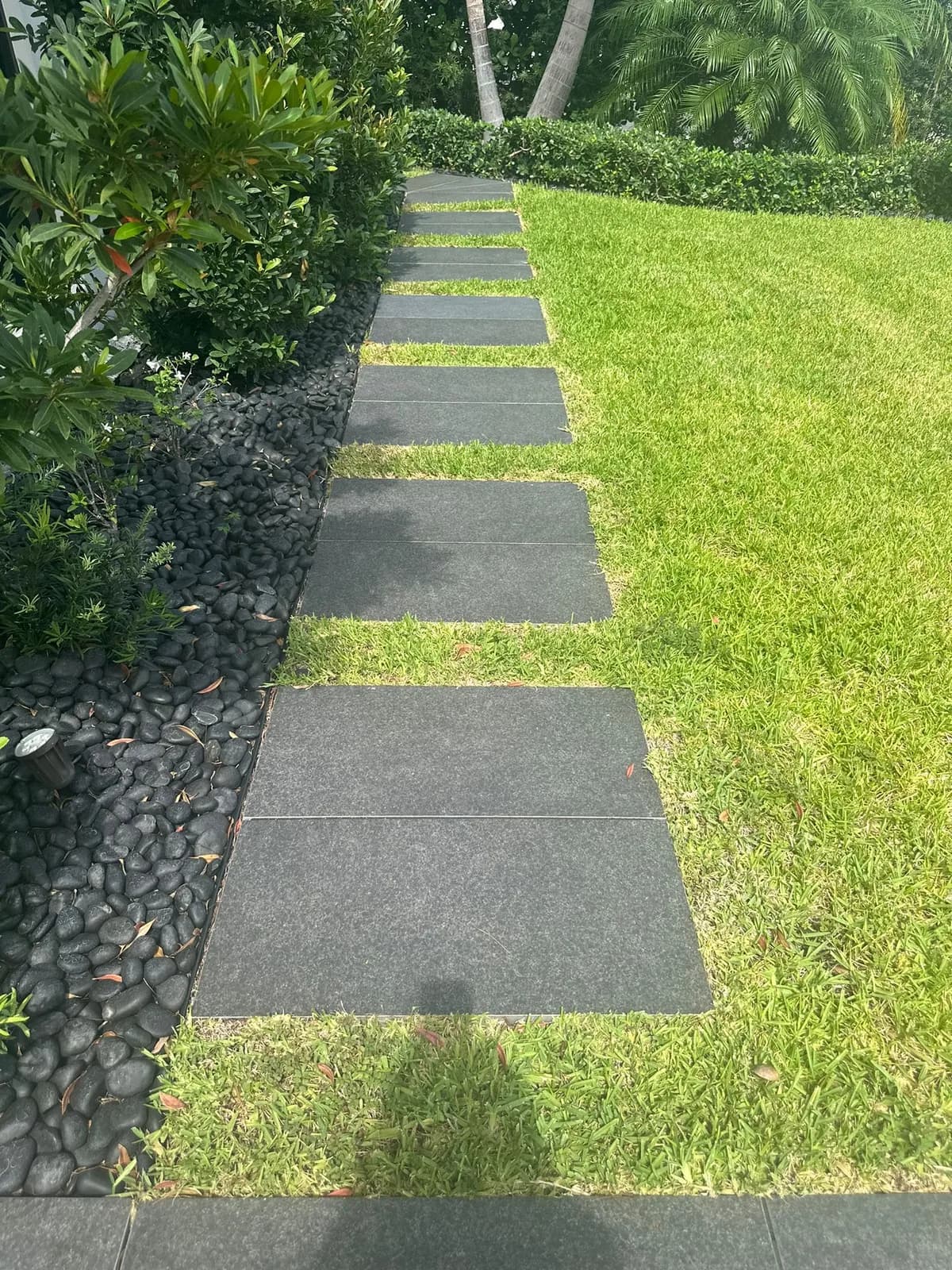
Manufacturers tell you these pavers are fade-proof, frost-proof, non-porous, and slip-rated, and on all four counts they are telling the truth — we have pulled up eight-year-old porcelain in this market and found the color unchanged under a patio table. What the catalog does not mention is the face count. A wood-look or marble-look paver is a printed pattern, and a collection with only six or eight unique faces will visibly repeat across a large deck once your eye finds the pattern; premium lines carry far more variation. So dry-lay a full box before setting anything, shuffle across pallets rather than working one at a time, and look at the sample outdoors in direct Florida sun rather than under showroom lighting, because veining that reads as subtle indoors can read as loud at noon. Long planks have their own rule: never lay 48-inch planks on a 50 percent offset. Use a third or less, or the natural crown in the middle of each plank stacks up as lippage at the joints.
The other gap between brochure and backyard is thickness and substrate. Spec 2CM for pool decks, patios, and lanais, and 3CM anywhere a vehicle drives — the catalog states both numbers but rarely translates them, and we have been called out to porcelain driveways set in 2CM that cracked under an SUV. Over an existing slab, porcelain goes down bond-set with full mortar coverage, and every control joint in that concrete has to be carried straight up through the porcelain as a soft movement joint, or the slab will crack the paver along the line it wanted to move. Within about five miles of the water — Siesta Key, Longboat, the canal streets off Cortez — we grout with epoxy rather than cementitious, because salt exposure eats a standard grout joint long before it touches the porcelain. Large-format slabs also demand a substrate flat enough that no edge telegraphs a shadow line. That product-specific detailing is exactly what the Hardscape.com certification trains for, and it is why the same paver can look extraordinary on one deck and merely fine on the one next door.
The real material vs. its porcelain counterpart in Florida
| The look you want | Real material upkeep | Porcelain version upkeep | What changes in Florida |
|---|---|---|---|
| Teak or hardwood deck | Sand, oil or stain yearly; replace failed boards | Broom and hose | No rot, splinters, cupping, or annual sanding and oiling |
| Polished marble deck | Reseal; polish out etching | Broom and hose | No etching from chlorine or salt; R11 texture instead of slick polish |
| Filled travertine | Reseal every 18–24 months | Broom and hose | No resealing; no chloride absorbed through voids |
| Wood-look plank format | n/a | Broom and hose | Plank cuts and lippage control add labor over square formats |
| Large-format 24x24 or larger | n/a | Broom and hose | Fewer joint lines, but requires a dead-flat substrate to set |
Bond-setting over a sound existing slab is the leanest route because no excavation or base is required; a full tear-out and base rebuild costs more. Coastal jobs inside about five miles of open water add epoxy grout.
Financing Available
See your monthly payment before you decide
Compare real offers from more than twenty lenders through Acorn Finance, our financing partner. It takes about a minute, and checking does not affect your credit score.
Pay the way that suits you: credit and debit cards, bank transfer or check — or finance the project over monthly payments through our partner.
- Offers from 20+ lenders
- Pre-qualify in about 60 seconds
- No impact on your credit score

Financing is provided through Acorn Finance, an independent lending marketplace. EC Paver Solutions is not a lender and does not set rates or terms. Pre-qualification uses a soft credit inquiry and does not affect your credit score; final rates and terms come from the lender and are subject to approval.
Frequently Asked Questions
Do wood-look porcelain pavers look fake?+
Can you use marble-look porcelain around a saltwater pool?+
Is wood-look porcelain cheaper than a real wood deck in Florida?+
What size are wood-look porcelain pavers?+
Which is better for a Florida pool deck: travertine or travertine-look porcelain?+
See the Look on Your Own Deck Before You Commit
Bring us the picture in your head — the teak lanai, the veined marble pool deck, the warm travertine courtyard — and we will put real samples down on your actual slab, in your actual light, at the hour of day you use the space. You will see the face variation, feel the R11 texture, and get a written spec covering thickness, layout, grout, and movement joints before anyone quotes a number. EC Paver Solutions is the only Hardscape.com Certified porcelain paver installer in Sarasota, Manatee, Hillsborough, Orange, Lee and Pasco Counties. Call (941) 250-4635.

Written by
EC Paver Solutions
EC Paver Solutions delivers premium paver installation across Sarasota, Bradenton, Lakewood Ranch, Tampa, Orlando, and Fort Myers. Hardscape.com Certified — the only certified hardscape contractor across five Florida counties.