

Why Porcelain Is Florida's Best Low-Effort Surface
The resort-at-home pool deck, cool enough to cross barefoot at 3 p.m. in August and still matching its sample in year ten, is not a brochure fantasy. Here is exactly why porcelain delivers that look in Florida, what the upkeep really is (a broom and a hose), and what it costs in Sarasota and Tampa.
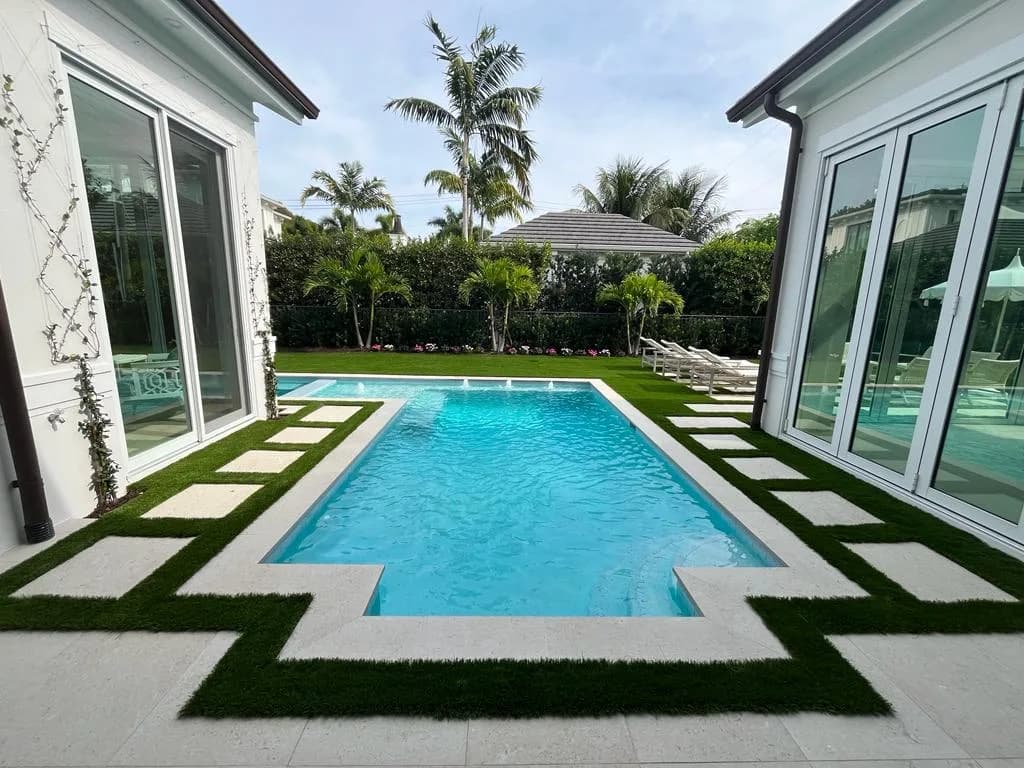
The Resort-at-Home Deck, and Why It Stays That Way
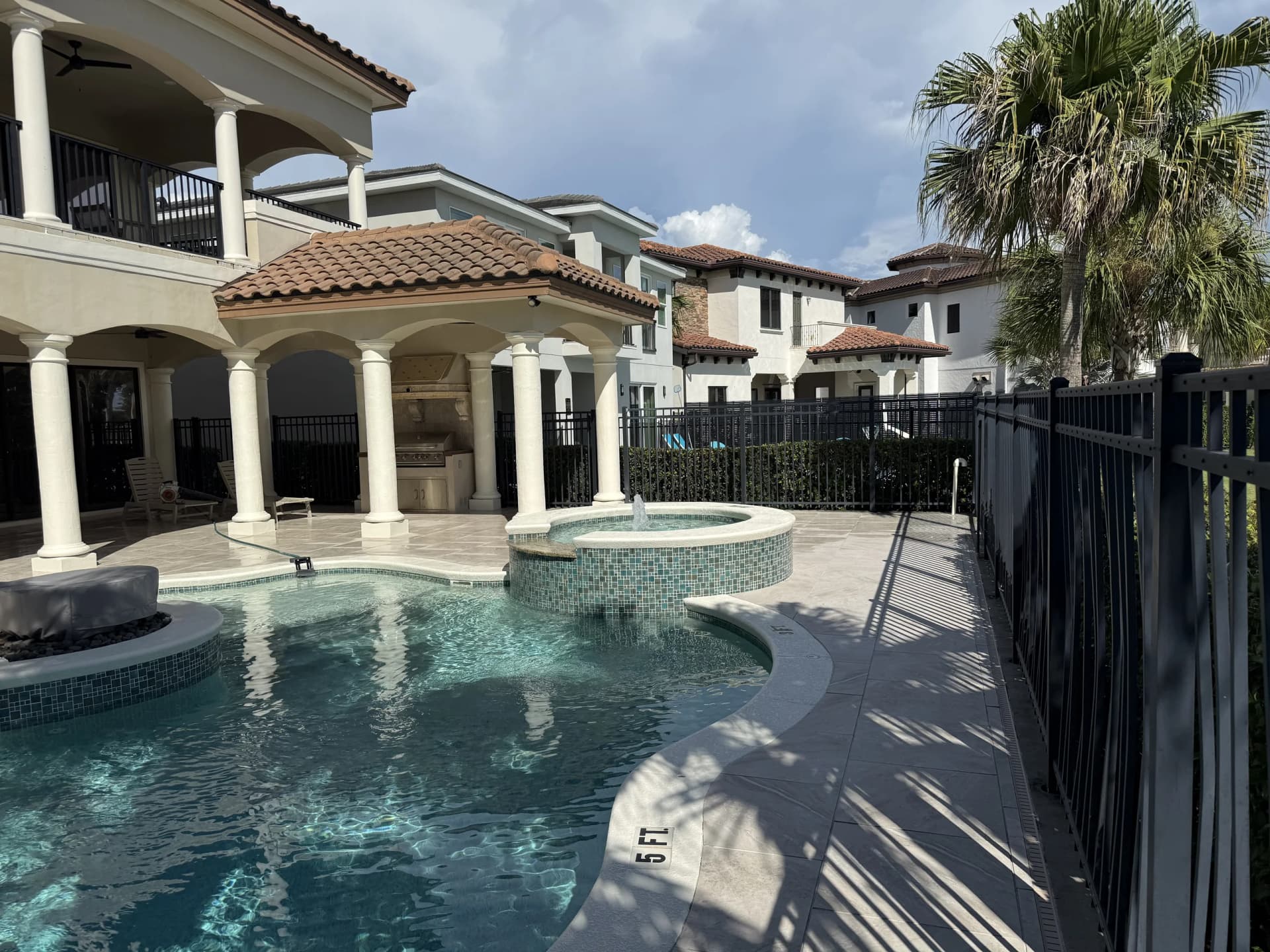
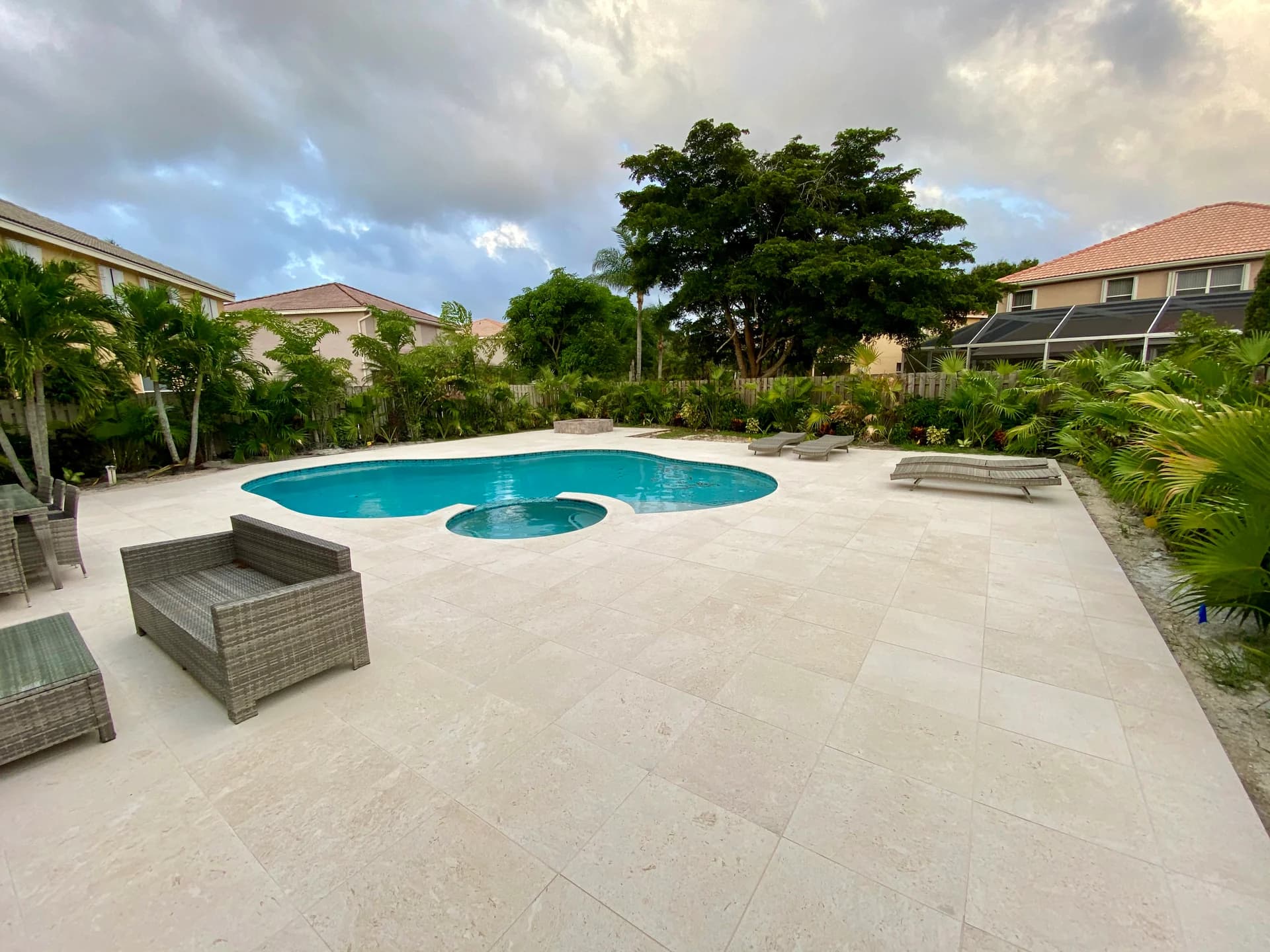
Picture three o'clock on a Tuesday in August. The pool is 88 degrees, the kids are cannonballing off the step, and you walk from the lanai slider to the coping barefoot without doing the hot-sand shuffle. The deck under you is a pale, warm-ivory porcelain in a 24 by 24 format, and it reads like the pool terrace of a boutique hotel on Siesta Key: long clean lines, joints so tight they almost disappear, a fine stone texture that catches the late light. Neighbors walking a dog down the street slow down to look. That is the backyard most people are picturing when they call us, and the honest news is that porcelain is the material most likely to deliver it and keep delivering it. Not because of a marketing adjective, but because of how the material is physically made, which is worth two minutes of your time before you spend a dollar.
A porcelain paver is refined clay and feldspar pressed under enormous pressure and fired at roughly 2,200 degrees Fahrenheit until the body vitrifies, meaning the particles fuse into a dense, glass-like mass. The result absorbs less than half a percent of its weight in water, compared with several percent for a concrete paver and considerably more for natural travertine. That single number is behind almost everything you will enjoy about it. Water, sunscreen and spilled sangria sit on the surface instead of soaking in. Mold and algae have no pores to root into during a wet July. And because the color is fired into the face or runs through the body rather than being a coating on top, there is nothing to wear through by the pool steps. On an unshaded Lakewood Ranch deck that swings close to 40 degrees at the surface every day, a light-toned porcelain also stays noticeably cooler underfoot than a dark concrete paver, which is the 3 p.m. comfort you actually feel.
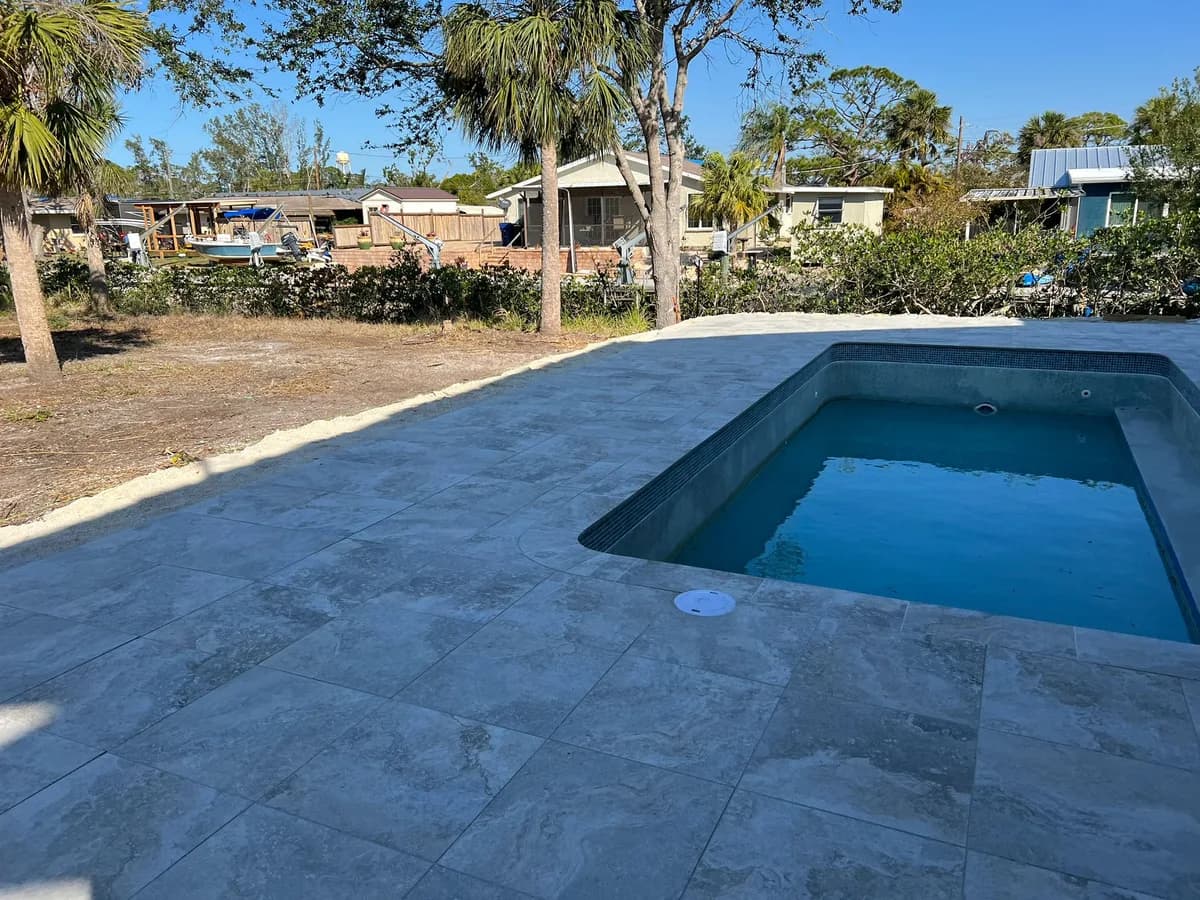
Year Ten Still Matches the Sample
The most satisfying moment in this business comes years after the install, when a client pulls the original sample out of the garage, sets it on the deck, and genuinely cannot tell which is which. That is what fired color does under Florida sun. Concrete pavers get their color from pigment mixed into cement, and on a south-facing Sarasota pool deck that pigment chalks and softens over several summers until the charcoal border reads as tired gray. Travertine keeps its color but changes its face, as the pits open and the honed surface roughens. Porcelain color is locked in by the kiln, so ultraviolet light has nothing organic to break down. The deck you approved in a showroom in March is the deck you are standing on in year ten, which, when you consider what a pool deck costs, is the whole point of spending the money.
Pool chemistry and salt are where the difference becomes obvious. Saltwater chlorinators are standard in new Manatee and Sarasota pools, and every splash leaves a film of salt that dries, draws moisture and dries again. In porous stone and concrete, that salt crystallizes inside the pores and slowly spalls the surface, which is why you see flaking coping on ten-year-old decks in west Bradenton. Porcelain gives salt nowhere to crystallize, so the tile simply rinses clean. The same density shuts out efflorescence, the white bloom that wicks up through concrete pavers from a damp base after a week of summer storms. Near the Gulf, on Anna Maria Island or Longboat Key, we pair the tile with an epoxy or high-performance joint so the grout holds up as well as the porcelain does. Chlorine splash, sunscreen and rust from patio furniture legs all stay on the surface, where a mild cleaner lifts them off.
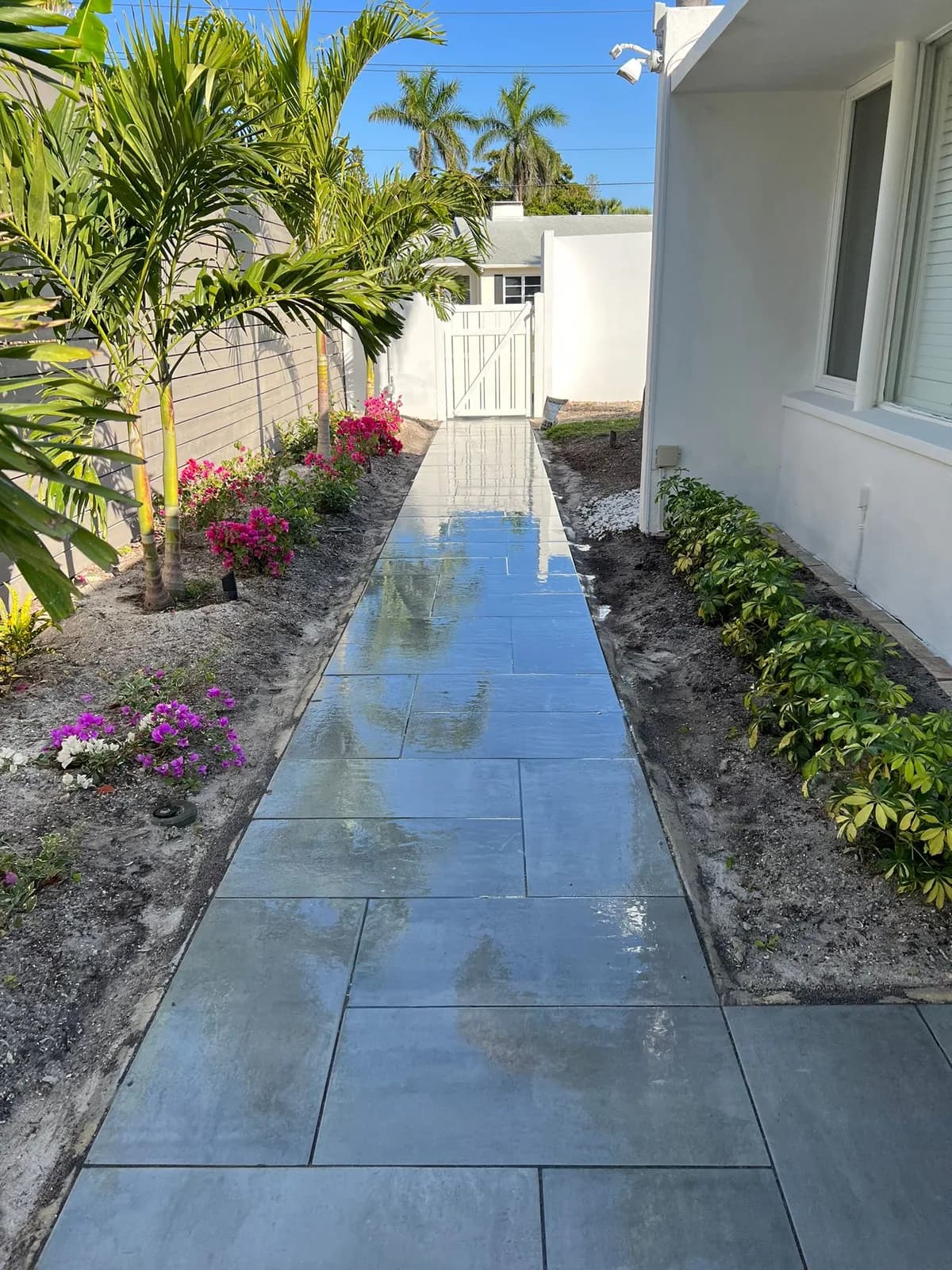
The Weekends You Get Back
Here is the entire maintenance routine for a porcelain deck in Florida, and it fits in one paragraph. Sweep with a soft broom when leaves and oak pollen pile up. Rinse with a garden hose after a windy week or a pool party. For a spill, use warm water with a few drops of dish soap and a soft brush. Once or twice a year, if you like, run a low-pressure wash to freshen the joints. That is it. There is no sealer on the schedule, ever, because there is nothing porous to seal. Avoid bleach, ammonia, wire brushes and acid cleaners, which do nothing for the tile and can dull the grout, and you have covered the whole manual. Most of our Palmer Ranch clients tell us the hose does ninety percent of the work, and the afternoon summer rain quietly does a surprising amount of the rest.
Compare that with the calendar that comes with other surfaces. Concrete pavers in our market typically want cleaning and resealing every two to three years to keep color and joint sand in place, and a professional clean-and-seal runs roughly $1.50 to $3 per square foot here. On a 900-square-foot pool deck, that is $1,350 to $2,700 per cycle, plus the weekend nobody can use the deck while it cures. Unfilled travertine beside a salt pool often wants resealing every 12 to 18 months. Across three or four cycles in a decade, the sealing line alone can run $4,000 to $10,000, before you count the lost Saturdays. Porcelain costs more up front, but its upkeep budget is a bottle of dish soap and a broom. The real luxury is not the tile itself; it is spending your weekends living on the deck instead of working on it.
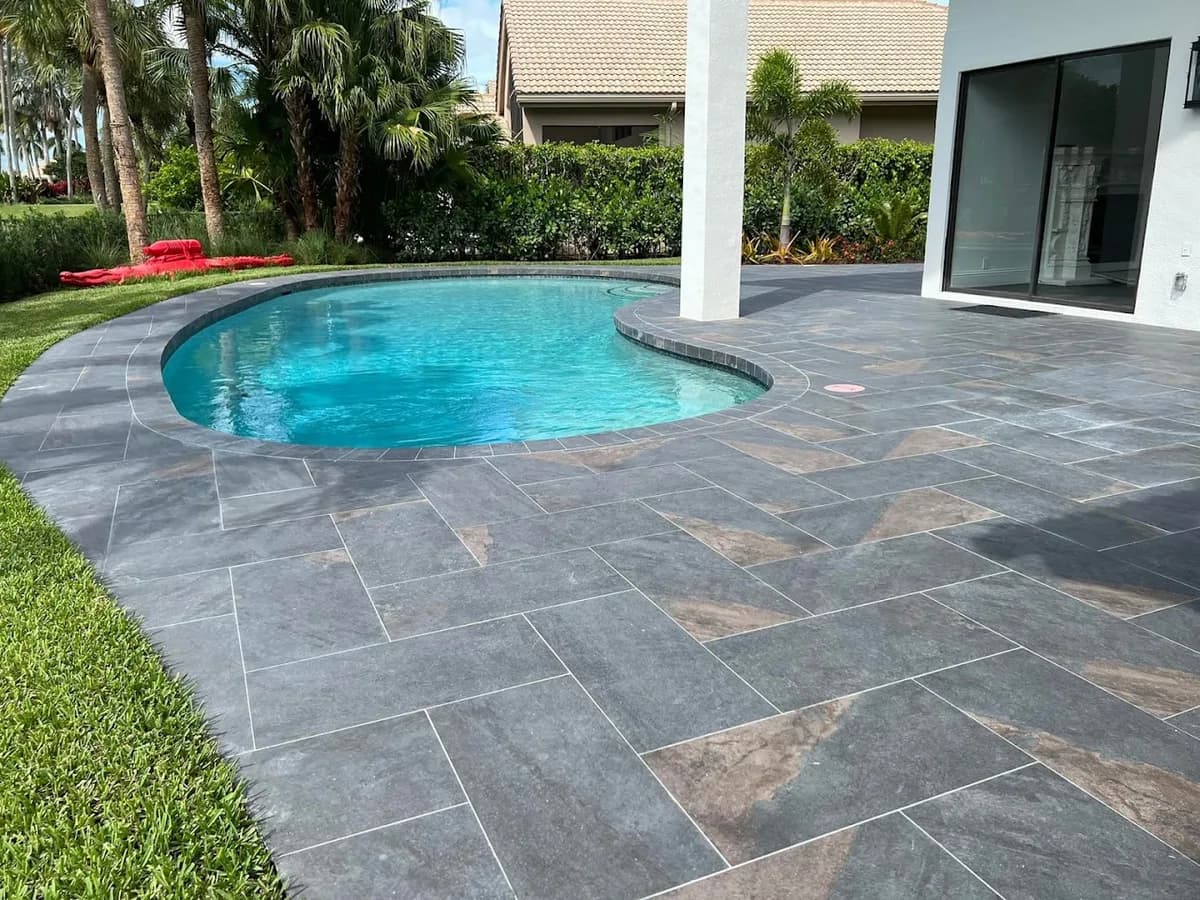
Beauty You Can Choose, Grip You Can Trust
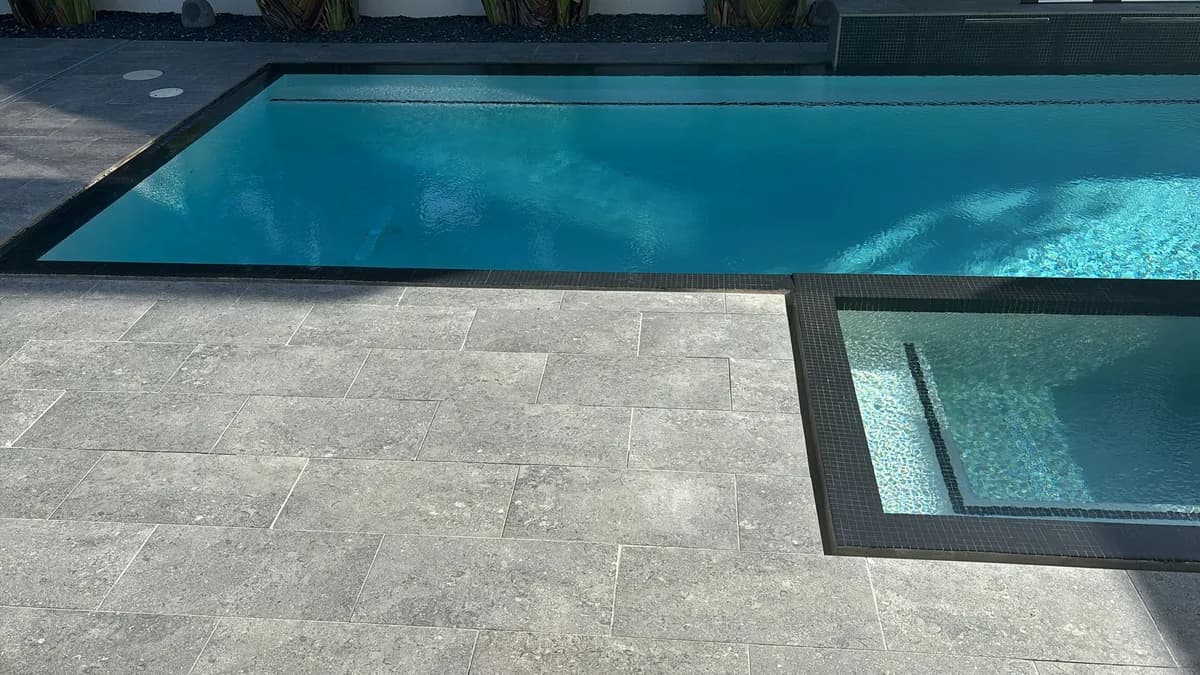
Because the look is fired rather than quarried, porcelain lets you pick a mood and get exactly that mood. The Hardscape.com Da Vinci collection is a marble look, warm browns and grays with cream and white veins running through each paver, and on a pool deck it gives you the drama of polished stone without stone's thirst for water. Wood-look planks bring the warmth of teak to a screened lanai with no splinters, no rot and no 150-degree board under a bare foot. Travertine-look porcelain, including Belgard's Travertini line, keeps the soft Mediterranean pattern Sarasota loves without the open pits that collect grit. And the defining 2026 move is large format, 24 by 24 and bigger, where fewer joint lines make a modest deck read calmer and noticeably larger, and the floor seems to continue straight out through open sliders to the water.
Beauty you are afraid to walk on is not beauty around a pool, so the finish matters as much as the look. For the wet band beside the coping we specify a textured R11 slip-resistant surface, which grips a wet foot while still reading smooth to the eye. Then the install has to deserve the tile. Porcelain is rigid, so it needs a dead-flat, stable substrate: bond-set over a sound slab with full mortar coverage and every control joint carried up as a flexible movement joint, or laid on compacted limerock in lifts over our sandy, high-water-table soil. That product-specific precision is what our Hardscape.com certification trains, and it separates a deck that looks like the rendering from one with lifted edges. In Sarasota and Tampa, budget roughly $18 to $30 per square foot installed, with a sound existing slab landing near the lower end.
Financing Available
See your monthly payment before you decide
Compare real offers from more than twenty lenders through Acorn Finance, our financing partner. It takes about a minute, and checking does not affect your credit score.
Pay the way that suits you: credit and debit cards, bank transfer or check — or finance the project over monthly payments through our partner.
- Offers from 20+ lenders
- Pre-qualify in about 60 seconds
- No impact on your credit score

Financing is provided through Acorn Finance, an independent lending marketplace. EC Paver Solutions is not a lender and does not set rates or terms. Pre-qualification uses a soft credit inquiry and does not affect your credit score; final rates and terms come from the lender and are subject to approval.
Frequently Asked Questions
Are porcelain pavers worth the money in Florida?+
Do porcelain pavers get hot in the sun?+
Do porcelain pavers need to be sealed?+
Are porcelain pavers slippery when wet?+
How long do porcelain pavers last outdoors?+
See Your Deck in Porcelain Before You Commit
Bring us the look you have been saving on your phone, whether that is marble veining, warm wood planks or a calm large-format field. We will walk your deck in Sarasota, Bradenton, Lakewood Ranch, Tampa, Orlando or Fort Myers, set real samples down in your own afternoon sun so you can feel them barefoot, and leave a written, itemized spec covering base, thickness, finish and joints. Call (941) 250-4635 to book it.

Written by
EC Paver Solutions
EC Paver Solutions delivers premium paver installation across Sarasota, Bradenton, Lakewood Ranch, Tampa, Orlando, and Fort Myers. Hardscape.com Certified — the only certified hardscape contractor across five Florida counties.