
Hardscape.com CertifiedThe ONLYCertified Porcelain Paver Installer in Sarasota, Manatee, Hillsborough, Orange, Lee & Pasco Counties
(941) 250-4635
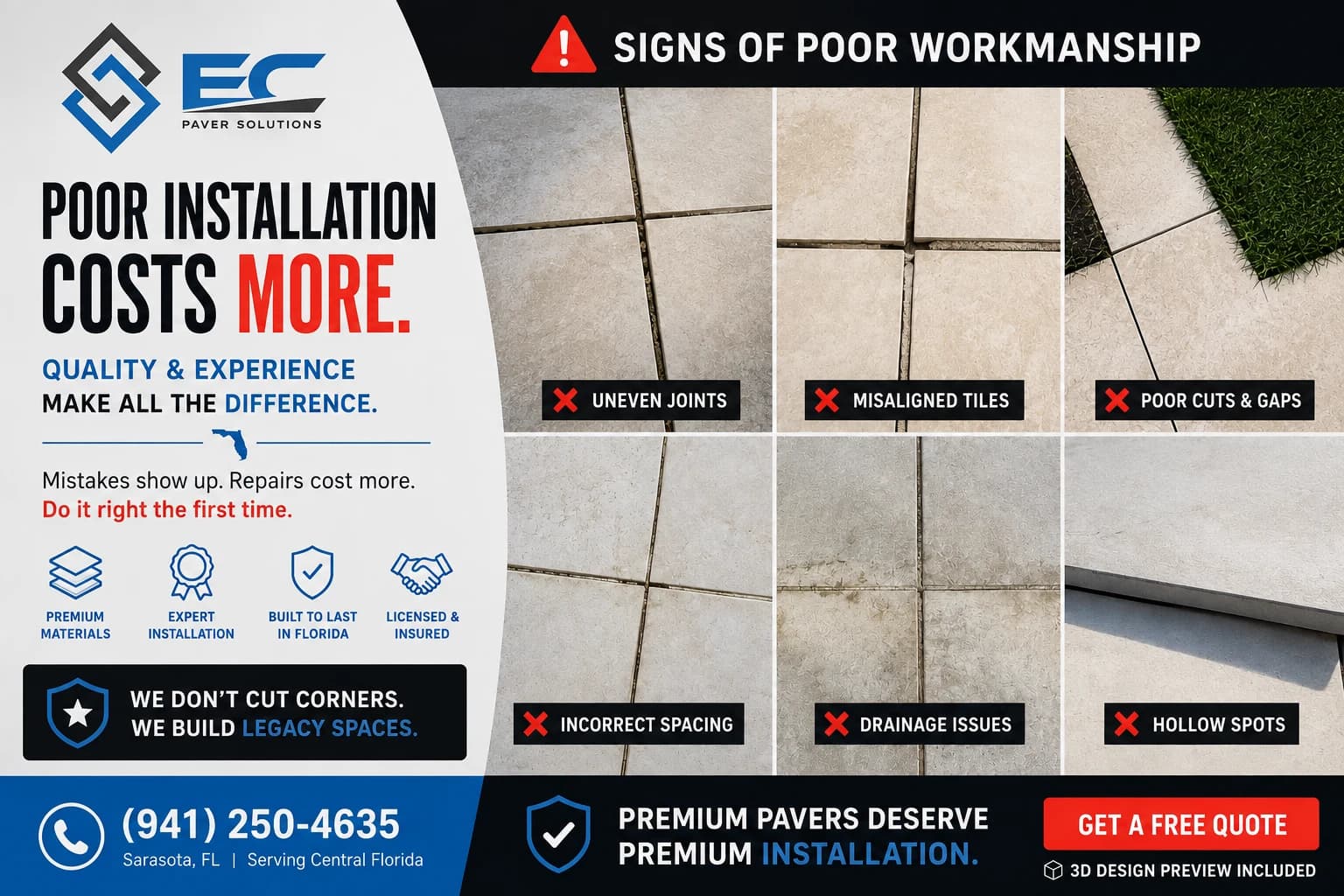
Six documented signs of poor porcelain paver workmanship: uneven joints, misaligned tiles, poor cuts, incorrect spacing, drainage issues and hollow spots

Installation Failure

The cheapest bid becomes the most expensive deck

Six signs your pavers were installed wrong — what each one actually means, and why it is almost never the material's fault.

Nobody sets out to buy the same deck twice.

A failed porcelain installation almost never looks failed on the day the crew drives away. It looks finished. The tile is the tile you chose, the colour is right, and the surface is flat enough that nothing announces itself. The problems are underneath, and they surface on their own schedule — usually across the first wet season, sometimes in the second summer.

By then the crew is unreachable, the manufacturer points at the installation, and the quote to put it right is larger than the difference between the cheap bid and the proper one ever was. That is the whole arithmetic of this trade, and it is worth seeing clearly before you sign anything.

What follows is not a sales page. It is what we look for when we assess a deck somebody else built, photographed on real jobs, with the reason each defect happens and what the specification actually required instead.

What to look for

Six signs, and what each one is telling you

Every photograph below is a real installation defect. Walk your own deck with this list before you call anybody, including us.

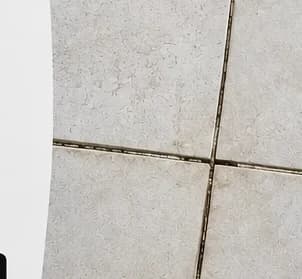
Uneven porcelain paver joints of varying width with debris, a sign of failed installation Sign 1

Joints that wander in width

The grout lines are wider in some places than others, and they collect dirt in the wide spots. On a large-format field the eye reads it instantly, even from a distance.

What went wrong

The field was set without spacers or a layout plan, so the accumulated error from each course was pushed into the joint instead of being designed out. Once three or four courses have drifted, there is nowhere left to hide it.

What it required

Joint width is set before the first tile goes down, not corrected at the end. A dry layout establishes where the cuts land and keeps the error distributed instead of concentrated.
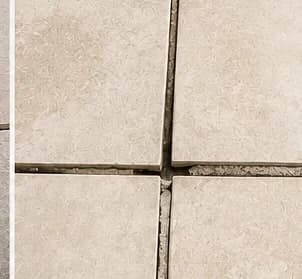
Misaligned porcelain pavers with one edge higher than the next, showing lippage Sign 2

Tiles that sit at different heights

Run a bare foot across the field and you catch an edge. In low sun the shadow line along each raised edge makes the whole surface look restless.

What went wrong

This is lippage, and on large-format porcelain it usually traces to two things: mortar that was not fully embedded under the tile, and a bond pattern with too much offset. Large tiles carry a slight crown, so a 50 percent offset lands the high centre of one tile against the low corner of its neighbour.

What it required

ANSI A137.1 allows 1/32 inch of lippage for joints between 1/16 and 1/4 inch. The TCNA recommends a maximum offset of about 33 percent for large-format tile — which is why a 30 percent running bond is the working standard on porcelain pavers, not the 50 percent brick pattern.

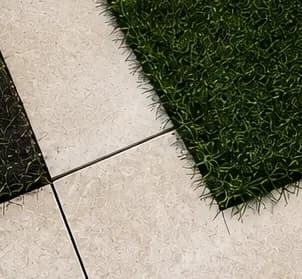
Poorly cut porcelain paver leaving a gap at the turf edge, a sign of rushed installation Sign 3

Ragged cuts and gaps at the edges

Where the field meets turf, a step, a drain or a wall, the cut is chipped, out of square, or leaves a gap filled with jointing material instead of tile.

What went wrong

Porcelain at 2CM and 3CM needs a wet saw with a continuous-rim blade and a steady feed rate. Cuts rushed on a dry blade chip the glazed edge, and an out-of-square cut gets buried in the joint because redoing it costs a whole tile.

What it required

Perimeter cuts are planned in the dry layout so no cut lands narrower than about half a tile. The edge is where a job either reads as finished or reads as rushed — there is no third option.

Porcelain pavers with inconsistent spacing and a joint closing to nothing Sign 4

Spacing that changes across the field

Some joints are tight to the point of touching, others are open. Where tile meets tile with no gap, the jointing material has nowhere to go.

What went wrong

Porcelain expands and contracts with temperature, and a joint that closes to nothing leaves the field no room to move. Under Florida sun a bonded deck can swing well over 30 degrees between dawn and mid-afternoon, and that movement has to go somewhere.

What it required

Consistent joints plus movement joints carried through the field and around the perimeter — at the house, at pool coping, at columns. A field bonded edge to edge with no relief is a field waiting to tent.

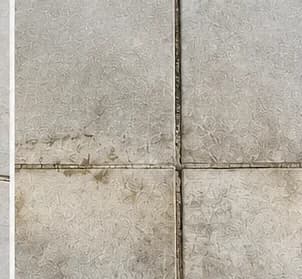
Standing water staining and organic growth along porcelain paver joints from poor drainage Sign 5

Water that sits, and joints that stain

After rain there are puddles that take hours to clear, and the joints darken with staining and organic growth along the low runs.

What went wrong

Porcelain has near-zero porosity, so unlike concrete pavers nothing drains through the surface. Every drop has to run off. When the slope was faked by varying the thickness of the mortar bed instead of being built into the substrate, the result is both a weak bed and a surface that holds water.

What it required

A base slope of roughly 1.5 to 3 percent, and about 1/4 inch per foot on a pool deck. Critically, the slope belongs in the substrate — building it out of mortar thickness produces uneven support and structural weakness.

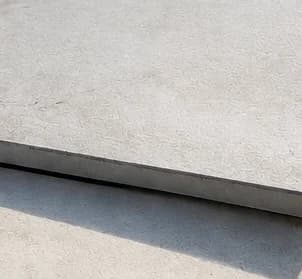
Porcelain paver edge lifting and separating from the bed, indicating hollow spots and bond failure Sign 6

Tiles that sound hollow when tapped

Tap across the deck with a knuckle or a coin and the tone changes. The hollow ones are the ones that will crack first, usually at a corner, usually under a chair leg.

What went wrong

The mortar was spot-set or combed in one direction and never back-buttered, leaving voids under the tile. A void under a 2CM piece means a point load has nothing beneath it, and porcelain that is unsupported at the edge breaks rather than flexes.

What it required

Full coverage under exterior tile, achieved by back-buttering and beating the tile in so the mortar ridges collapse. On an exterior deck the target is effectively complete contact, not the partial coverage tolerated on an interior floor.

The part nobody says out loud

There is no standard to hide behind

Here is the part of this trade almost nobody says out loud. Outdoor porcelain is not covered by a settled installation standard — neither the Tile Council of North America nor the Concrete Masonry & Hardscapes Association has formally adopted exterior porcelain paver installation into its published standards. The material arrived faster than the rulebook.

That gap is exactly where failed decks come from. A concrete paver crew reads the format — big, flat, rectangular — and installs what it already knows: a compacted base, a bedding layer of sand or stone dust, and the pieces set dry. It looks right on the day it is finished.

But at 2CM and 3CM, porcelain is classified as tile, not as paver. It has no interlocking geometry, no aspect ratio that transfers lateral load to its neighbours, and not enough mass to hold its own position. Set dry on sand, it is not a system. It is six failure modes waiting for a wet season.

Which means the specification is not written on a wall somewhere for the crew to follow. It is carried by the people doing the work. Certification and manufacturer training are not a badge on a truck — for this material, in this climate, they are the only thing standing between a deck that lasts and a deck that gets demolished.

What redoing it actually involves

The second invoice is not the first invoice again. It is the first invoice plus everything below — which is why the phrase “we can always fix it later” is the most expensive sentence in this trade.

  1. 1

    Demolition

    The failed field comes out. Bonded tile does not lift cleanly, so in practice the surface is broken out rather than salvaged — and the material you already paid for goes in the dumpster.

  2. 2

    Disposal

    Porcelain and mortar debris is heavy and it is construction waste. Hauling and tipping are a real line on the second invoice that did not exist on the first.

  3. 3

    Substrate correction

    Whatever caused the failure is usually in the base: slope built out of mortar, compaction that was never verified, drainage that was never planned. That is rebuilt properly, which is the work that should have happened first.

  4. 4

    New material

    You buy the tile a second time, and dye-lot matching on the original run is rarely possible after a year or two — which often means redoing adjoining areas that were fine.

  5. 5

    Reinstallation

    The full bonded assembly, done to specification. This is the only line item that was ever really optional — and only in the sense that you can choose to pay for it once instead of twice.

None of it is unusual. All of it is avoidable. The only step that was ever optional is the last one — and only in the sense that you can choose to pay for it once instead of twice.

Straight answers

Tap across the field with a knuckle — a change in tone means a void under the tile. Run a bare foot over the joints; if you catch edges, that is lippage. After rain, look for puddles that linger more than an hour, and check whether the joints are the same width across the whole deck. Any one of those on its own can be a detail. Three of them together is an installation problem, not a maintenance problem.

Because they are not the same product. At 2CM and 3CM, porcelain is classified as tile. It has no interlocking geometry, no aspect ratio that transfers load sideways to its neighbours, and not enough mass to hold its own position. A concrete paver locks into the field around it; a porcelain paver does not. Set dry on sand the way concrete pavers are set, it has nothing holding it — which is why the failures show up as hollow spots, crept joints and broken edges rather than simple settling.

Not a settled one, and that is the heart of the problem. Neither the Tile Council of North America nor the Concrete Masonry & Hardscapes Association has formally adopted exterior porcelain paver installation into its published standards — the material moved faster than the rulebook. What exists is manufacturer specification and installer training. That is precisely why certification matters more here than on almost any other hardscape product: there is no code for a crew to fall back on.

It depends on whether the fault is in the surface or in what is under it. Isolated hollow tiles or a run of failed joints can often be addressed in place. But when the slope was built out of mortar thickness, when compaction was never verified, or when hollow spots appear across the whole field, the problem is the assembly itself and patching it only buys time. We tell you which one you have after assessing it, in writing, including when the honest answer is that you do not need us yet.

Usually yes. Manufacturer warranties are conditional on installation following published guidelines, and installation outside those guidelines voids coverage. Worse, even an intact product warranty typically covers the value of the material only — not the labour to demolish the failed field, rebuild the base and reinstall. That gap between what the product warranty covers and what the repair actually costs is the real expense of hiring the cheapest bid.

We are the only Hardscape.com certified installer across Sarasota, Manatee, Hillsborough, Orange, Lee & Pasco Counties, our crews are trained on this specific material, and we put the base depth, the slope, the bedding method, the jointing and the movement joints in writing on the quote before anything is ordered. We also back our own workmanship for five years. A contractor who will not specify the base in writing is telling you something.

Have it assessed before it gets worse

Free on-site assessment across Sarasota, Manatee, Hillsborough, Orange, Lee & Pasco Counties. We tell you in writing what failed, why, and whether it needs a repair or a rebuild — including when the honest answer is that it can wait.

No obligation. We respond within 24 hours.

Or call (941) 250-4635