

What Goes Under Pavers in Florida: The Base Guide
The base is six to twelve inches of engineered material that goes invisible about four hours after it is finished, which is exactly why a low bid hides its savings down there. Here is the full assembly for Sarasota and Manatee sand — geotextile, three-inch lifts of crushed base, one inch of concrete sand — plus the compacted depth your walkway, patio, or driveway actually needs.
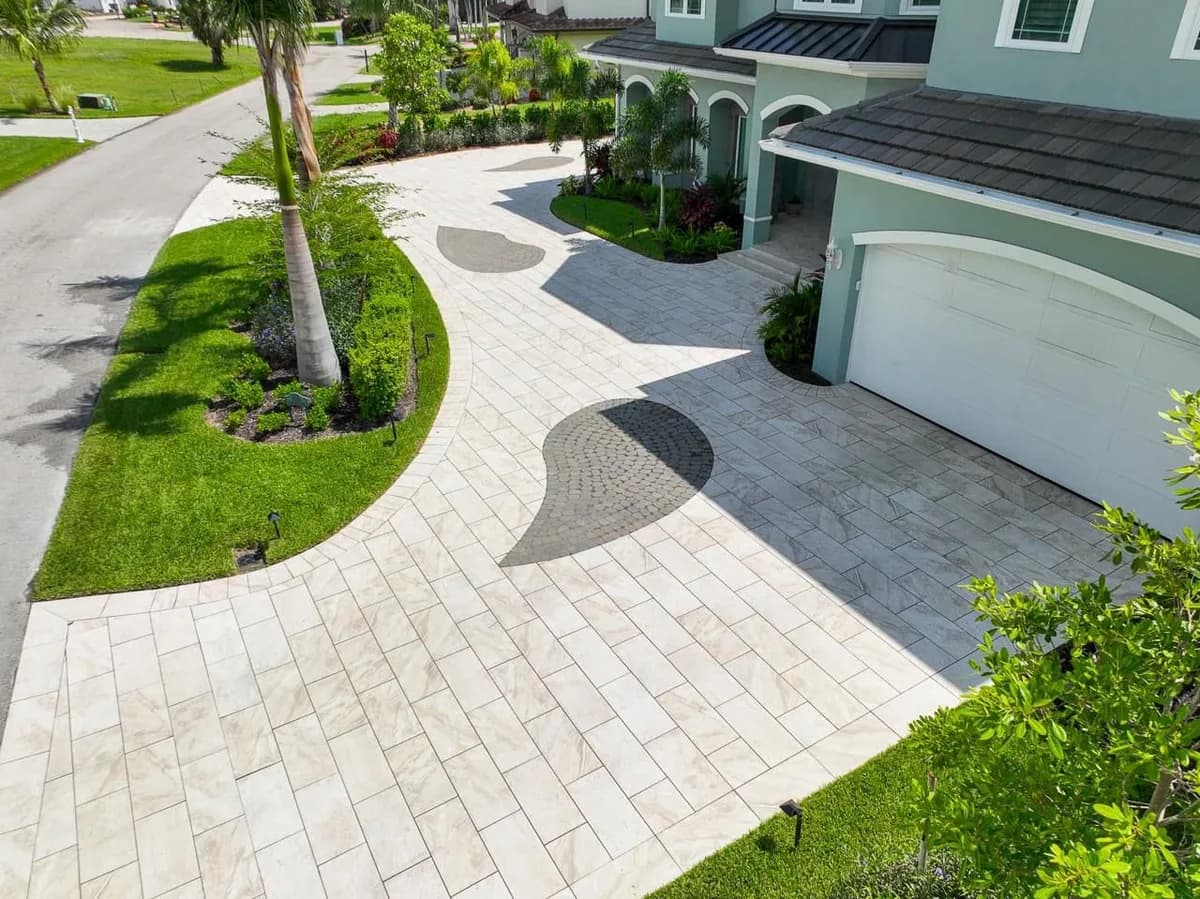
The Part of the Job You Will Never See Again
Everything you will ever judge this project on was decided before the first paver came off the pallet. Whether the patio still sits flat in year eight, whether the driveway holds its lines under a loaded F-250, whether water leaves the deck or stands in a low corner growing algae — none of that is a property of the paver. It is a property of the six to twelve inches of engineered material underneath it, and that work is buried and invisible within about four hours of being finished. This is exactly why the base is where a low bid finds its savings: nobody can inspect it after the fact, and the failure surfaces in year three, long after the check cleared. We have rebuilt driveways in Bradenton where the pavers themselves were in perfect condition — still square, still the right color — sitting on top of four inches of unwashed fill that had turned to pudding. The pavers were fine. The project was a total loss.
What sits under most of Sarasota and Manatee County is fine, poorly graded sand, the same material that makes Siesta Key famous, running down under your yard. It drains beautifully, which is the good news, and it has almost no cohesion, which is the entire problem. Compacted and dry it behaves like a solid; saturated after a summer cell drops two inches in forty minutes, it behaves like a liquid, and anything carrying weight goes looking for a new elevation. Add a wet-season water table sitting two to five feet below grade across much of the coastal plain, plus fifty-plus inches of rain a year concentrated into June through September, and you have a subgrade that gets loaded and unloaded constantly. A base designed for Ohio clay is the wrong answer here — and so is the local shortcut of skipping base entirely because the sand drains. Sand drains. Sand does not distribute load. Those are two different jobs, and a paver system needs both.
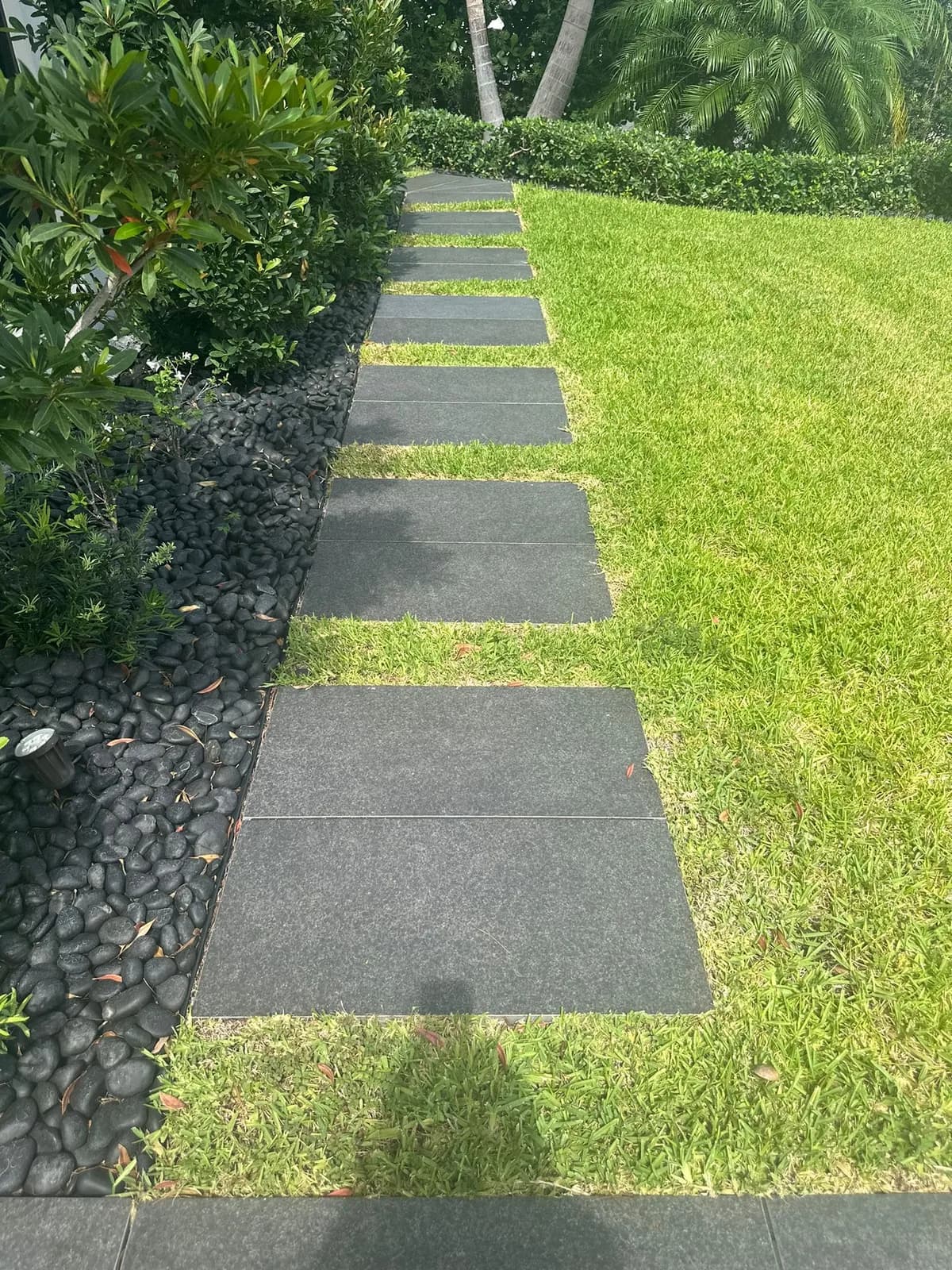
The Five Layers, Bottom to Top
Bottom to top, here is the actual assembly. First the subgrade: we excavate to depth, pull roots, muck, and any pocket of organic soil, then proof-roll and compact the native sand until it stops moving under the machine. A buried stump hole or an old fill pocket left in place will find you eventually, usually as a single sunken square in the middle of an otherwise perfect patio. Second comes geotextile — non-woven, needle-punched fabric, AASHTO M288 Class 2, laid across the compacted subgrade with generous overlaps at every seam. Every contractor in Florida has an opinion on whether fabric is necessary in sand, and ours is that it is cheap insurance we run on essentially every job. Its function is separation, not strength: it stops the fines below from pumping up into your base aggregate each time the water table rises and falls, which is the mechanism that quietly turns clean, well-graded rock into contaminated mush over five to ten years. Fabric costs cents per square foot. Rebuilding a driveway costs several times what the fabric would have.
Third, and this is the layer doing the structural work, is compacted crushed base rock. Around here that means crushed limestone, shell rock, or crushed concrete from a local pit — angular, well-graded material with fines that lock together under a compactor instead of rolling past each other the way round pea gravel does. The number that matters more than the material is the lift. Base goes down in three-inch lifts with each one compacted separately, because a plate compactor's energy dies off within a few inches, and dumping eight inches at once buys you a hard crust over a soft middle. That is the most common corner we find cut in this market, and it is completely invisible on day one. Fourth is exactly one inch of coarse washed concrete sand, ASTM C33, screeded flat and never compacted before the pavers land on it. It is a setting bed, not a leveling compound. Anyone using a thick sand bed to correct a base that was never made flat is building a washboard on a delay timer.
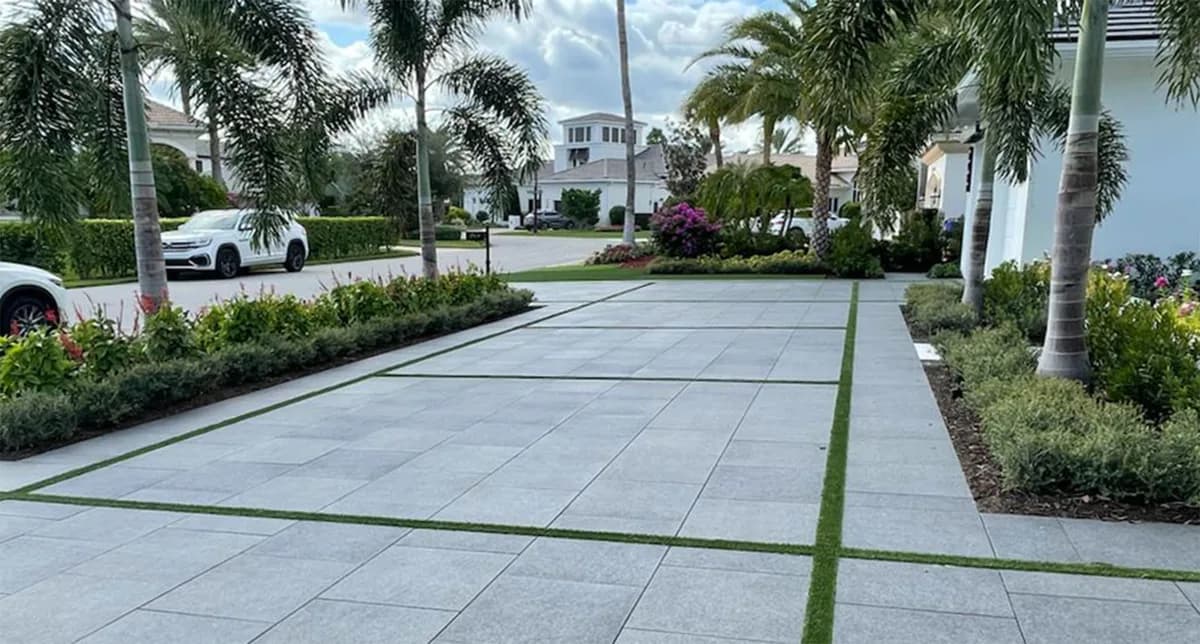
How Deep? Walkway, Patio, Driveway
So how deep. For a walkway or a screened lanai floor over stable, well-drained sand, six inches of compacted base is our working minimum. For an open patio or a pool deck, six to eight. For a residential driveway carrying a daily SUV, eight to ten, and for anything that sees a work truck, an RV, or a boat trailer, ten to twelve. Those are compacted depths, not the height of the pile before the machine runs, and the distinction matters because crushed base loses roughly 20 to 25 percent of its loose thickness when it is compacted properly — an eight-inch driveway base starts as about ten inches of material. Compaction targets follow ICPI practice: 98 percent standard Proctor for pedestrian areas, 98 percent modified Proctor for vehicular. If you want a single question that separates a real estimator from a guy quoting square footage over the phone, ask which of those two he is compacting to, and how many lifts it takes.
Three site conditions push those depths up, and an honest estimator names them before he prices the job rather than after. New construction is the first: a lot in a Lakewood Ranch phase filled and platted in the last three or four years has not finished settling, so we add two to four inches over what we would build on a 1990s Palmer Ranch street. Poor drainage is the second, and it is not solved by more rock — a corner where water stands after a storm needs the water routed out, because a thicker base built inside a bathtub is just a deeper bathtub. Organic or mucky subgrade is the third, and it gets excavated and replaced, never bridged. Then, whatever the depth, the perimeter has to be restrained: sand-set pavers are only as stable as their edge, so a spiked polymer or poured concrete restraint goes around every free edge and the joints get polymeric sand swept in and activated. Without an edge, the field creeps outward a fraction of an inch each season until the pattern loses its lines.
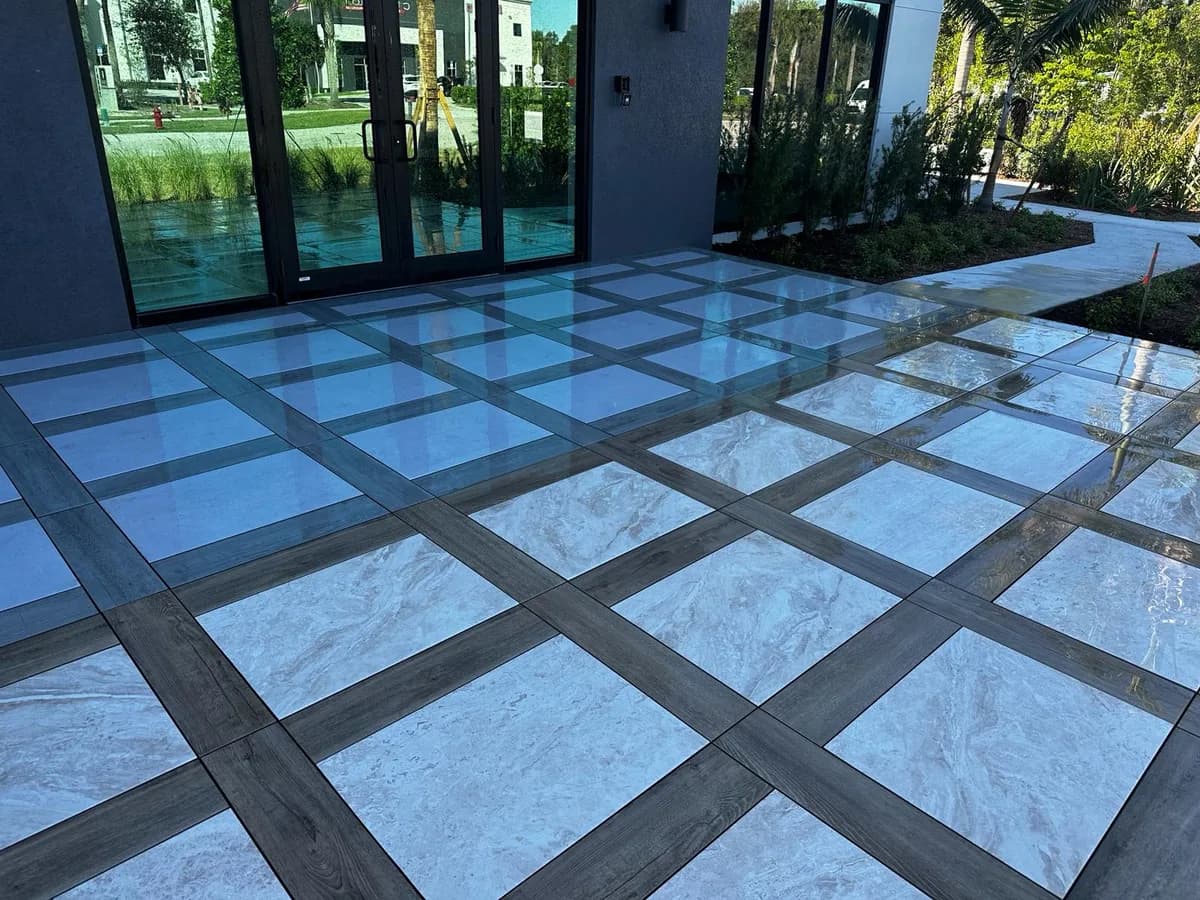
The Two Florida Wildcards: Water and the Existing Slab
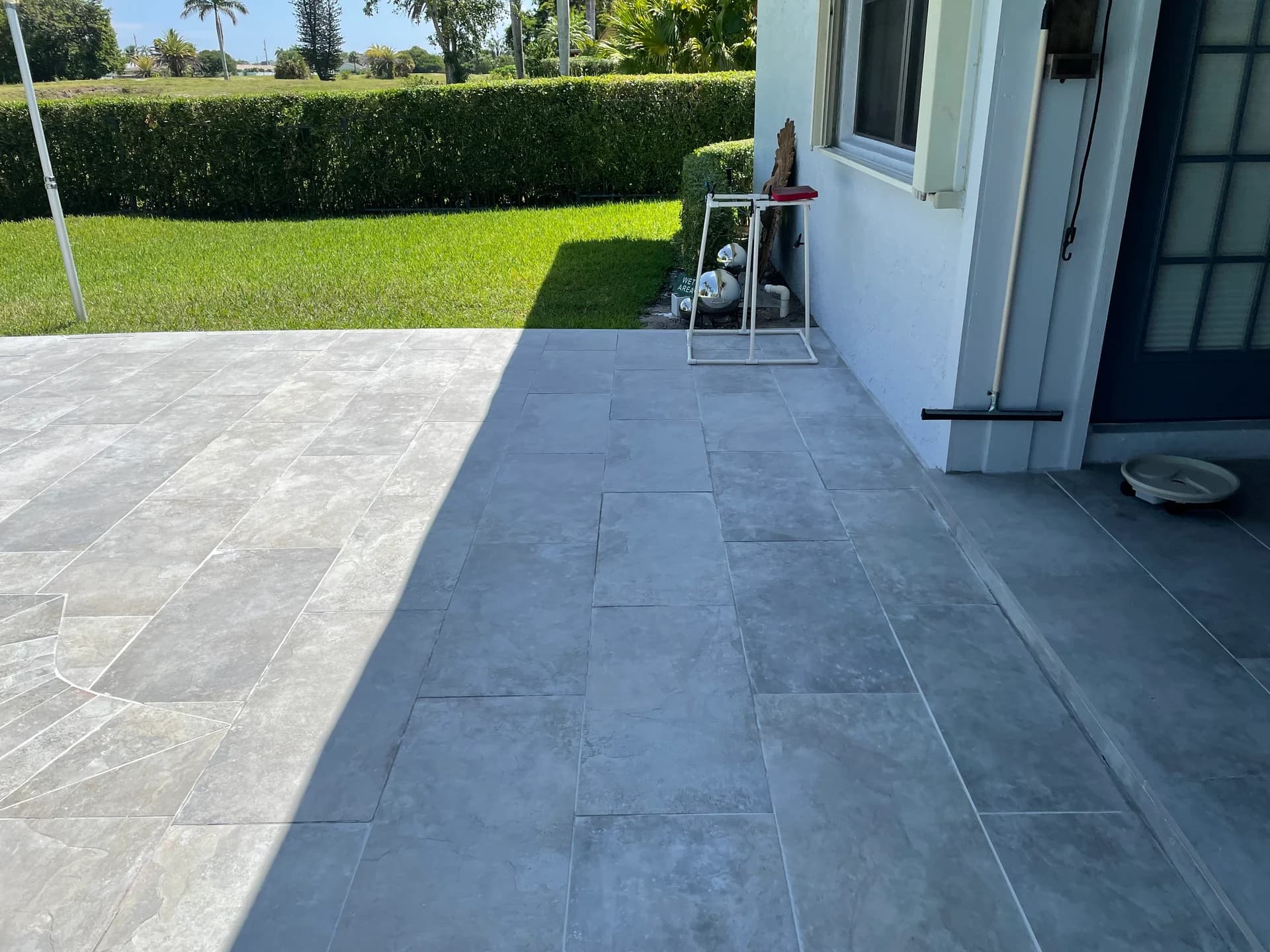
Two Florida-specific decisions determine whether that base ever gets tested. The first is fall. We hold a one to two percent slope, an eighth to a quarter inch per foot, away from the house, the pool coping, and the slider thresholds, and we decide where the water is going before we excavate rather than after we notice it ponding. A dead-flat deck is not a drainage annoyance you correct later; it is a base you saturate weekly all summer, and saturated base is base that moves. The second wildcard is what to do when a concrete slab is already there. On an older lanai, pool deck, or entry, that slab often is the base — provided it is structurally sound, without active settlement cracking — and porcelain goes down bond-set directly on top of it. That path skips excavation, hauling, and base material entirely, which is why porcelain over an existing slab usually comes in faster and cheaper than a tear-out and full rebuild.
Bond-set has its own rules, and they are unforgiving. The slab has to be profiled and clean, the setting material has to be an exterior-rated large-format system with full coverage under the slab — spot-bonding a 24 by 24 porcelain paver is how you get hollow corners that crack under a chair leg — and every control joint in the concrete has to be carried straight up through the porcelain as a soft movement joint. Concrete moves seasonally whether or not you gave it somewhere to go. If you did not, it will crack the porcelain instead, right along the line the slab wanted. That detail, plus substrate flatness tight enough that large-format slabs do not telegraph lippage as shadow lines, is precisely the product-specific training behind the Hardscape.com certification, and we are the only certified porcelain paver installer across Sarasota, Manatee, Hillsborough, Orange, Lee and Pasco Counties. What is underneath is the whole job. The pavers are just the part you get to look at.
Base spec by application — Sarasota and Manatee sandy subgrade
| Application | Compacted base depth | Bedding and compaction |
|---|---|---|
| Walkway or screened lanai floor | 6 in crushed base | 1 in concrete sand, 98% standard Proctor |
| Open patio or pool deck | 6–8 in crushed base | 1 in concrete sand, 98% standard Proctor |
| Residential driveway (car or SUV) | 8–10 in crushed base | 1 in concrete sand, 98% modified Proctor |
| Driveway with truck, RV, or boat trailer | 10–12 in crushed base | 1 in concrete sand, 98% modified Proctor |
| Porcelain bond-set over a sound existing slab | No excavation — the slab is the base | Full-coverage exterior thinset, movement joints carried up |
Sarasota and Manatee market pricing for base preparation only, before pavers and labor. On fill platted within the last three or four years, add 2–4 inches of depth. Muck or organic-soil removal is priced separately by the truckload, and a low corner that ponds needs drainage routed out before any of these depths mean anything.
Financing Available
See your monthly payment before you decide
Compare real offers from more than twenty lenders through Acorn Finance, our financing partner. It takes about a minute, and checking does not affect your credit score.
Pay the way that suits you: credit and debit cards, bank transfer or check — or finance the project over monthly payments through our partner.
- Offers from 20+ lenders
- Pre-qualify in about 60 seconds
- No impact on your credit score

Financing is provided through Acorn Finance, an independent lending marketplace. EC Paver Solutions is not a lender and does not set rates or terms. Pre-qualification uses a soft credit inquiry and does not affect your credit score; final rates and terms come from the lender and are subject to approval.
Frequently Asked Questions
How deep should a paver base be?+
Do you need gravel under pavers in Florida?+
Can you lay pavers directly on sand?+
What kind of sand goes under pavers?+
Do you need landscape fabric under pavers?+
See the Base Spec Before You See a Number
We will walk the site, tell you what is actually under your yard or your existing slab, and put the base in writing — excavation depth, geotextile, lift thickness, compacted base depth, bedding sand, edge restraint, and the fall we are holding for drainage. If your slab is sound, we will say so and price the porcelain bond-set instead of selling you a tear-out you do not need. EC Paver Solutions is the only Hardscape.com Certified porcelain paver installer in Sarasota, Manatee, Hillsborough, Orange, Lee and Pasco Counties. Call (941) 250-4635.

Written by
EC Paver Solutions
EC Paver Solutions delivers premium paver installation across Sarasota, Bradenton, Lakewood Ranch, Tampa, Orlando, and Fort Myers. Hardscape.com Certified — the only certified hardscape contractor across five Florida counties.