

9 Porcelain Paver Patio Ideas for Florida Homes
From a cool, pale resort deck you can cross barefoot in August to a marble-look terrace framed in wood-look planks, here are nine porcelain patio ideas we actually build in Sarasota, Bradenton and Tampa. Each one comes with the Florida detail that makes it last, and what it really costs.
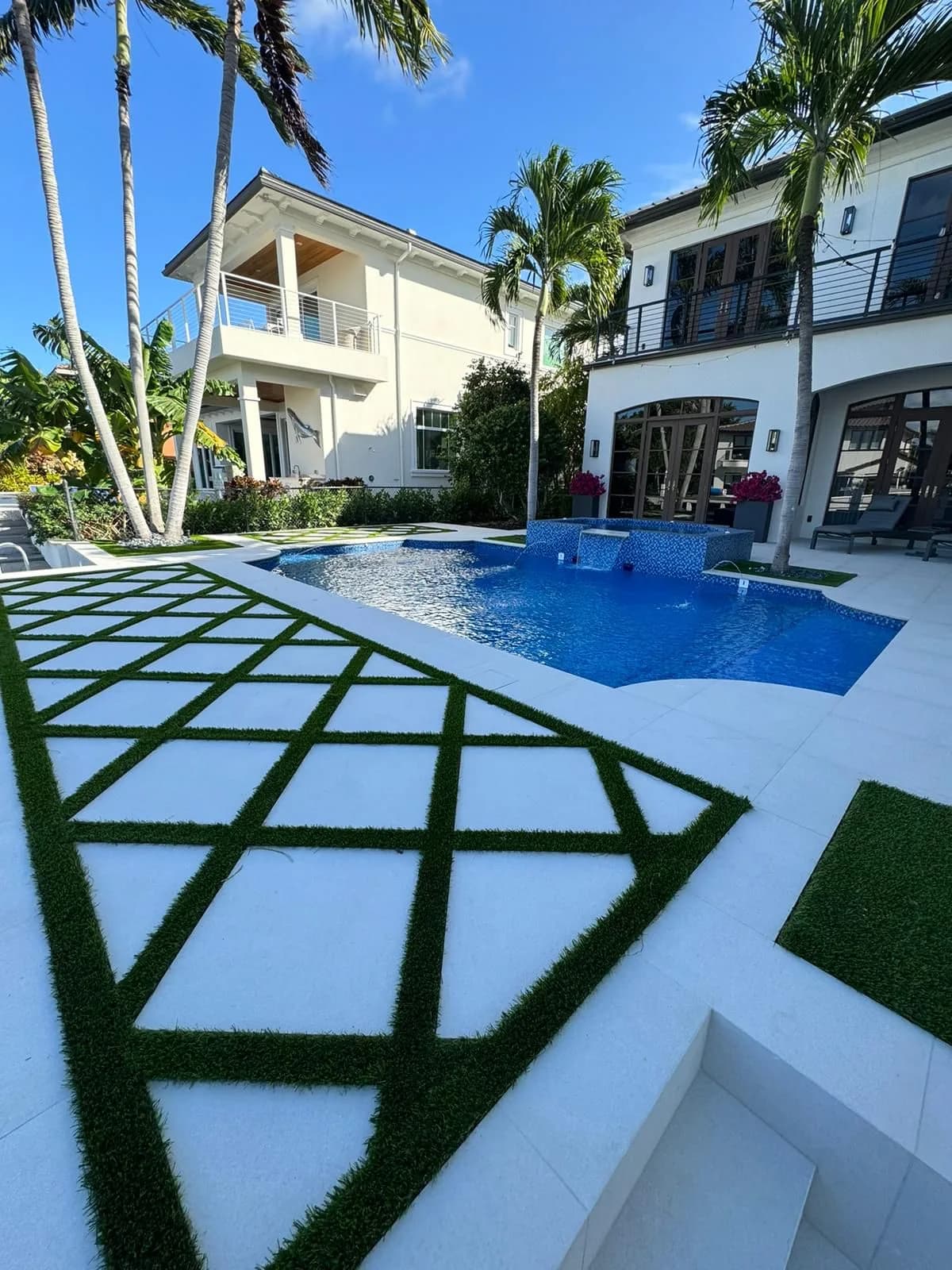
Ideas 1 and 2: The Cool Resort Deck and the Teak-Warm Lanai
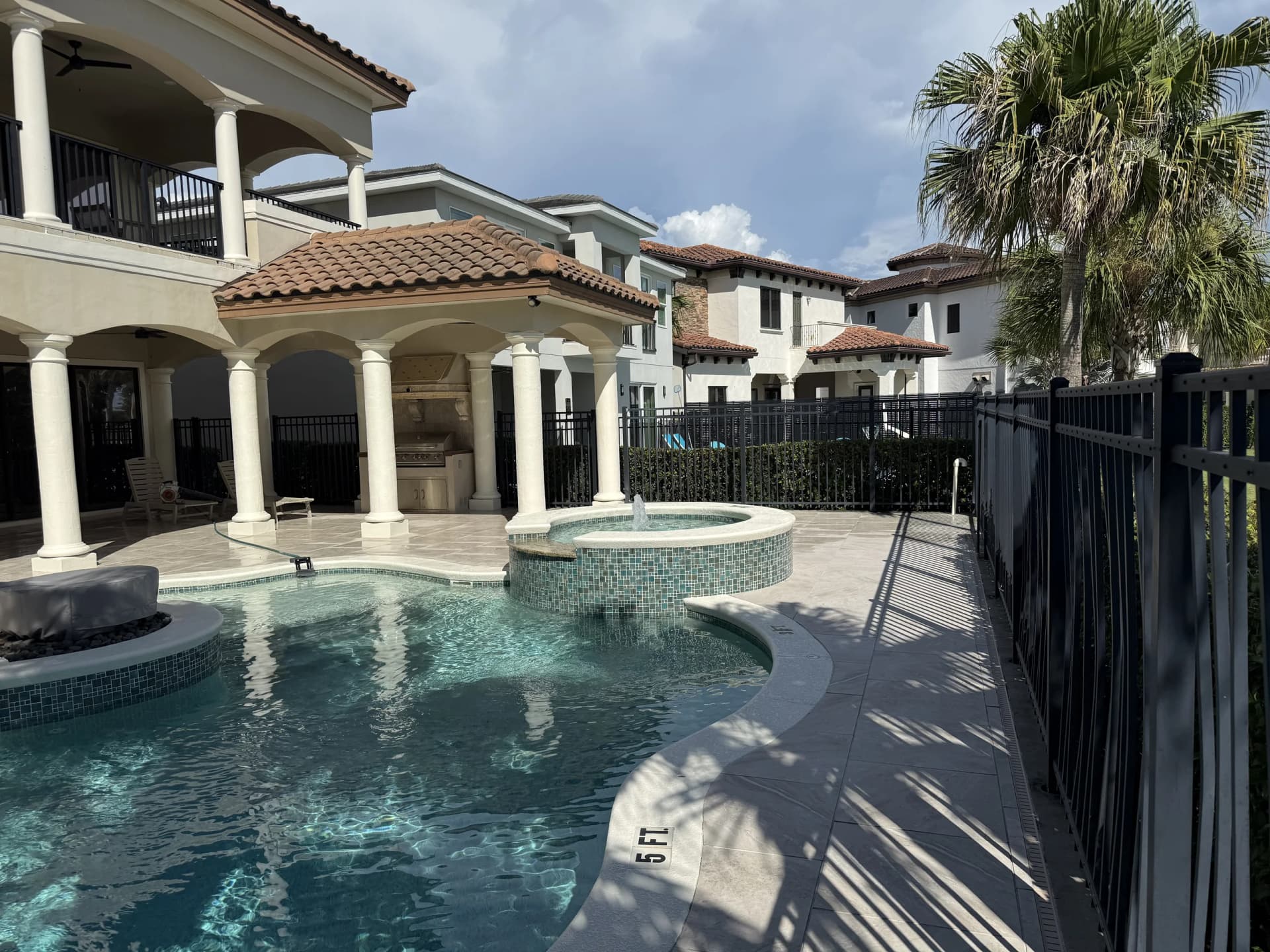
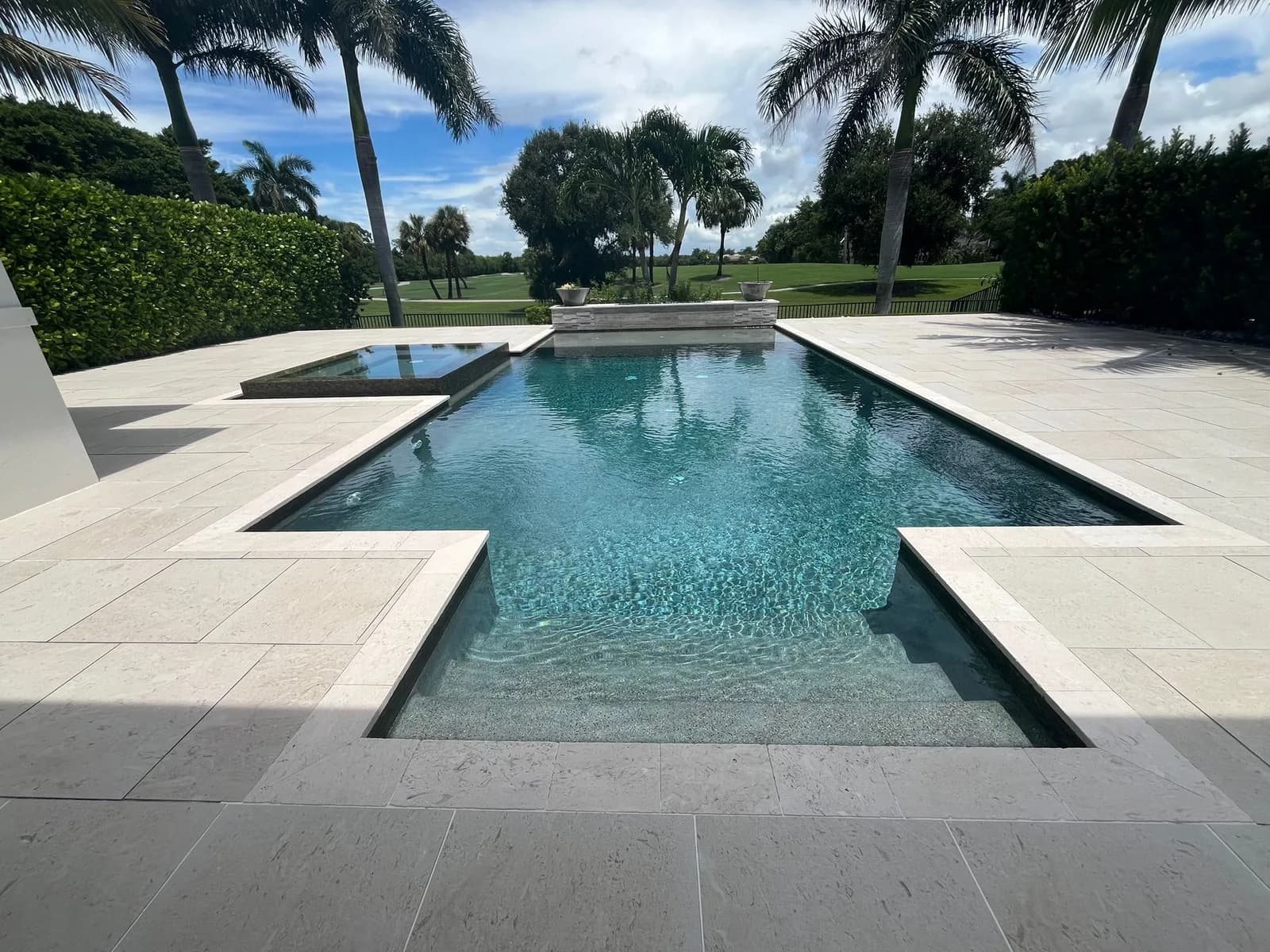
Idea one is the patio that makes guests ask who designed your yard: a resort-style pool terrace in a light, large-format stone look. Picture 24-by-24 or 24-by-48 pavers in ivory, snow white or pale limestone gray, running from the back sliders to the coping with joints so thin the deck reads as one calm plane. At 3 p.m. in August, when a dark concrete paver can climb past 140 degrees, a light porcelain surface typically stays 20 to 30 degrees cooler, so kids cross it barefoot instead of hop-skipping to the water. That comfort is physics, not marketing: light tones reflect more sun, and porcelain carries its pale color through the fired body rather than in a surface coat that UV slowly bakes away. For a playful twist, inlay strips of artificial turf in a diamond grid. Beside the pool we always specify a textured R11 finish, which grips a wet foot while still looking smooth from the lanai.
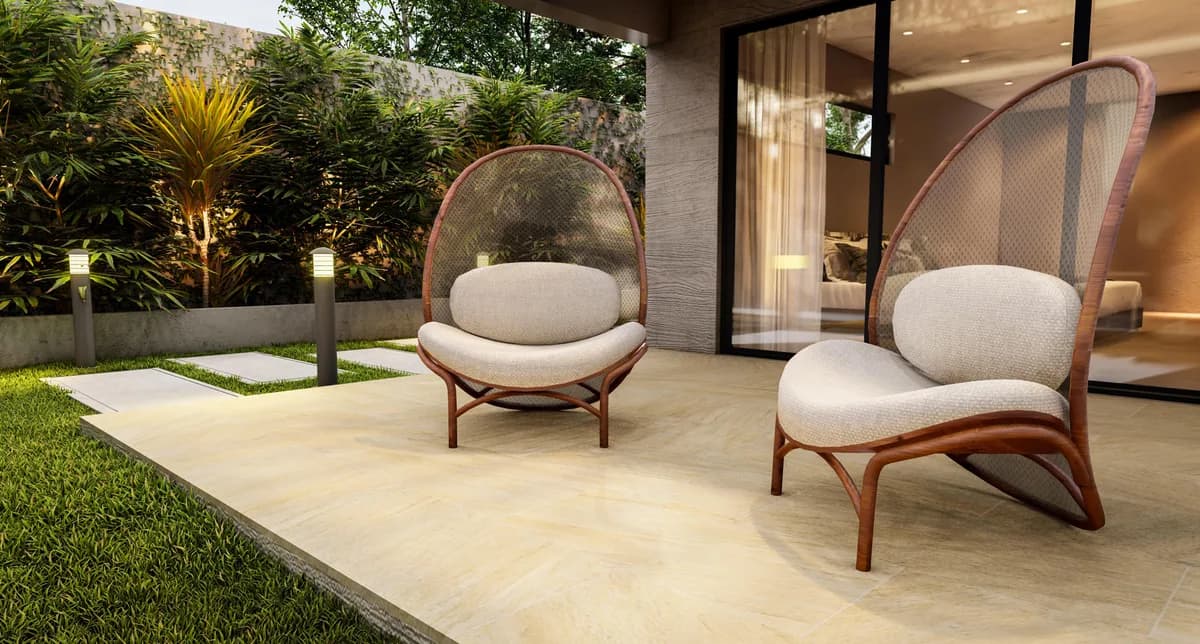
Idea two brings the warmth of a teak deck to a screened lanai without the boards that splinter, cup and bleach gray by their third summer. Wood-look porcelain planks, typically 8 by 48 or 16 by 48 inches, carry grain and knot detail printed and fired into the paver, so an evening under the ceiling fans feels like a Boca Grande beach house rather than a slab with patio chairs. Lay the planks in a staggered running bond parallel to the long wall to stretch a narrow lanai visually, or in a chevron to make a dining corner feel deliberate. Unlike real wood, porcelain shrugs off the afternoon storm that blows sideways through the screen, never feeds termites and never needs stain. The honest install note: long planks magnify any dip in the slab, so we check flatness with a straightedge and correct it before the first piece goes down, or the plank ends show lippage you will feel barefoot.
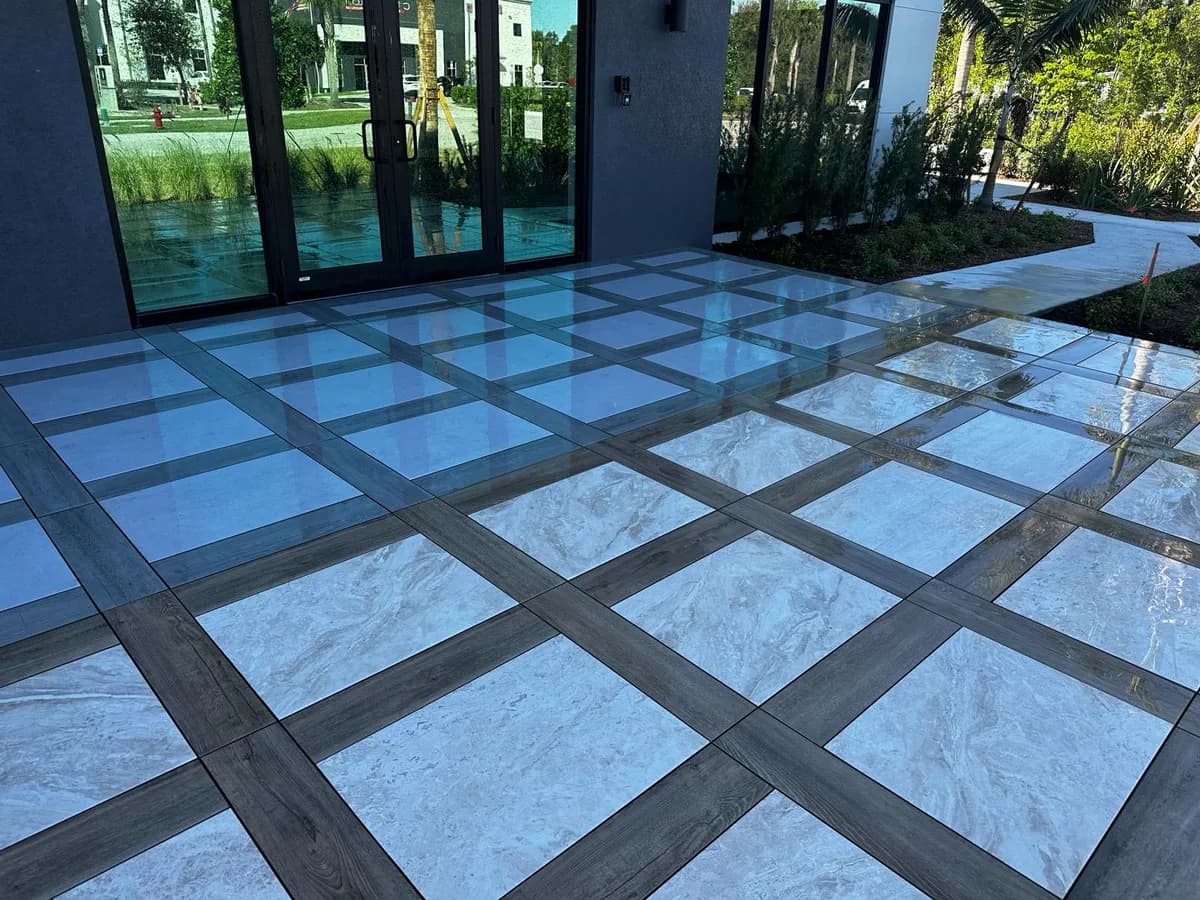
Ideas 3 to 5: A Marble Terrace, an Outdoor Kitchen and a Fire-Pit Room
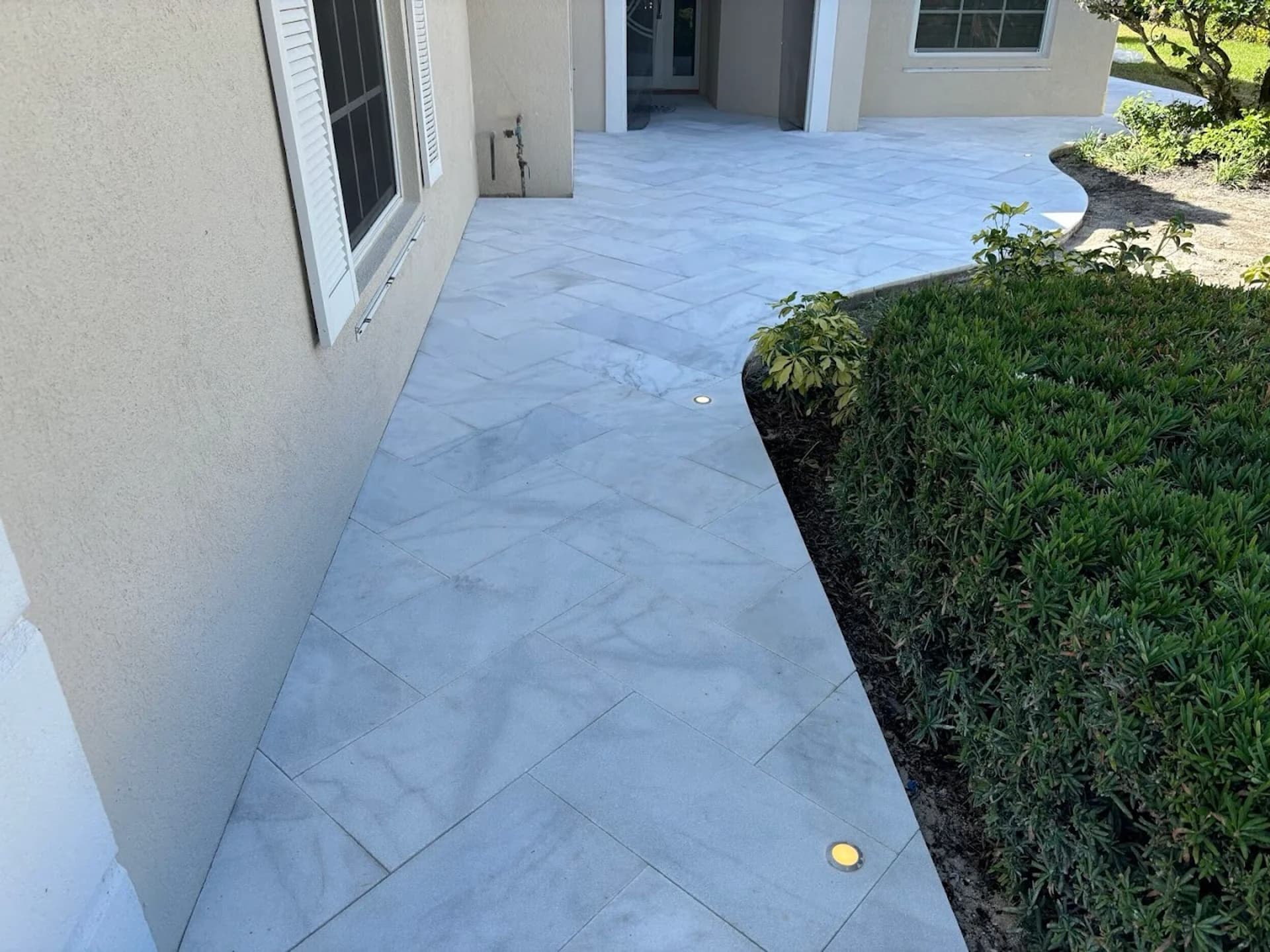
Idea three is for the homeowner who entertains: a marble-look terrace that turns the back of the house into an evening venue. The Hardscape.com Da Vinci collection shows what the category can do, with warm browns and grays and cream and white veining running across each paver, so a 400-square-foot terrace off the dining room glows like polished stone at golden hour. Push it further by framing each marble-look square with a border of wood-look planks, a grid that gives the floor architecture and hides the transition between rooms. Real marble would be a poor choice outdoors here; it is soft, it etches the moment lime juice touches it, and it drinks water all rainy season. Marble-look porcelain absorbs under half a percent, so last night's spilled red wine wipes off in the morning instead of becoming a permanent shadow. Choose a matte or textured outdoor finish wherever the surface gets wet.
Ideas four and five are about zones. An outdoor kitchen pad is where porcelain quietly outperforms everything else, because grill grease, barbecue sauce and cooking oil sit on top of a non-porous paver instead of soaking in the way they do in concrete pavers or travertine. A warm mid-gray stone look hides charcoal dust between rinses, and keeping about four feet of clear space in front of the grill keeps the cook out of the traffic path to the pool. Idea five is the fire-pit room: a round or square seating area, often outlined with a contrasting border, sized 12 to 16 feet across so chairs can pull back comfortably. In Lakewood Ranch and Palmer Ranch, where January evenings dip into the 50s, this is the patio that actually gets used in winter. Porcelain is fired at well over 2,000 degrees, but direct flame on a single paver can still shock it, so the fire bowl always sits on its own liner and base.
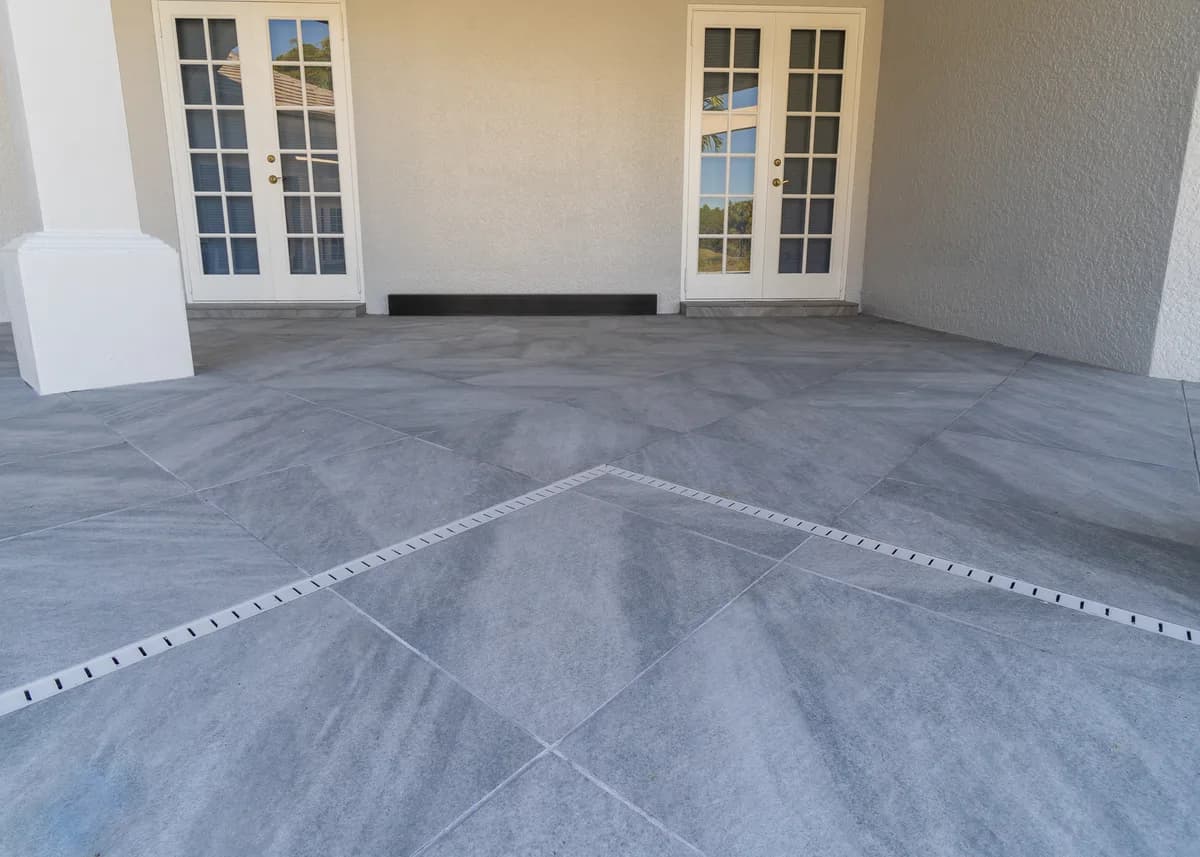
Ideas 6 and 7: Erase the Wall, or Transform the Slab You Already Have
Idea six is the 2026 look we are asked about most: the same porcelain flowing from the great room, across the slider track and out onto the patio, so with the glass pocketed open the house simply keeps going. It works because many collections are produced as an indoor tile and a 2cm outdoor paver with the same face, smooth inside and textured outside, so color and pattern match while the outdoor piece gets the grip it needs. The details that sell the illusion are small but decisive: aligning grout lines inside and out so they read as continuous, keeping the outdoor surface as close to interior height as code and drainage allow, and adding a slim linear drain at the threshold so a sideways August storm cannot ride into the living room. Done well, the patio stops feeling like an add-on and starts feeling like the best room in the house, the one with the sky for a ceiling.
Idea seven may be the smartest money on this list: porcelain bond-set directly over the plain concrete lanai slab most Bradenton and Sarasota homes already have. If the slab is sound, we skip demolition and excavation, profile the surface, set 2cm pavers in a full bed of polymer-modified mortar, and carry every existing control joint and crack up through the new surface as a flexible movement joint, so the slab can move without cracking the porcelain above it. The finished height rises only about an inch and a quarter, which often slips under the door threshold, but we measure before promising it. A tired gray slab on a 1990s house in west Bradenton becomes a wood-look or limestone-look floor in about a week, usually at the low end of what a full new patio costs. The honest caveat: a slab with heaved sections, active settlement or crumbling edges must be repaired first, because tile only hides those problems for a season.
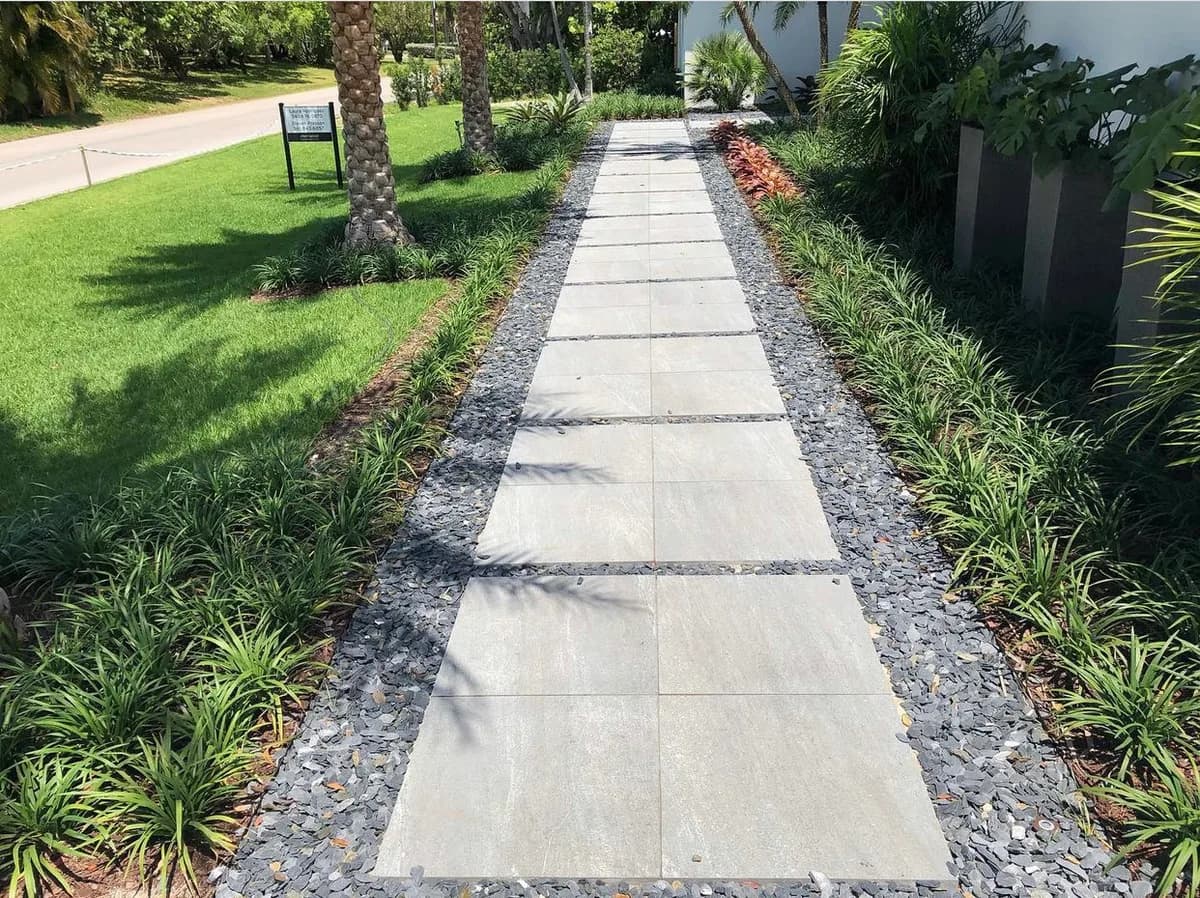
Ideas 8 and 9: The Garden Patio and the Salt-Air Courtyard
Idea eight is softer and easier on the budget: a garden patio where large 2cm porcelain pavers float in slate chips, river rock or turf, with open gaps between them. It suits a side-yard path, a route to the pool equipment or a small reading nook under a live oak, and it drains beautifully, because the summer downpour falls straight through the stone instead of sheeting across a solid surface toward the house. Under each paver we still build a real base, compacted crushed limerock over geotextile fabric, so our sandy, high-water-table soil cannot let individual pieces rock or sink after the first wet season. Pale 24-by-48 pieces give the composition a calm, modern rhythm, and dark charcoal pieces set in bright St. Augustine grass make a crisp graphic statement. With open joints there is no sand to wash out and nothing to refill. It also makes a smart first phase: build the path now and add the full patio once the budget allows.
Idea nine is for the coast: a Mediterranean courtyard on Anna Maria Island, Siesta Key or Longboat Key in a travertine-look porcelain such as Belgard's Travertini, with the soft Ivory patterning of real stone and none of the open pits where salt crystallizes. Within a few miles of the Gulf we grout with epoxy rather than cement, because salt air and spray slowly break down cementitious joints. Across all nine ideas, budget roughly $18 to $30 per square foot installed in Sarasota, Bradenton and Tampa, with bond-set over a sound slab near the low end and large-format pool terraces, curves and borders near the top. Big porcelain demands a dead-flat substrate and lippage control tight enough that no edge catches a bare heel, and that product-specific discipline is exactly what our Hardscape.com certification covers. Pick the idea that matches how you actually live outside, and we will lay real samples on your patio and price it in writing.
Financing Available
See your monthly payment before you decide
Compare real offers from more than twenty lenders through Acorn Finance, our financing partner. It takes about a minute, and checking does not affect your credit score.
Pay the way that suits you: credit and debit cards, bank transfer or check — or finance the project over monthly payments through our partner.
- Offers from 20+ lenders
- Pre-qualify in about 60 seconds
- No impact on your credit score

Financing is provided through Acorn Finance, an independent lending marketplace. EC Paver Solutions is not a lender and does not set rates or terms. Pre-qualification uses a soft credit inquiry and does not affect your credit score; final rates and terms come from the lender and are subject to approval.
Frequently Asked Questions
Are porcelain pavers good for patios in Florida?+
Do porcelain pavers get hot in the sun?+
Can you put porcelain pavers over an existing concrete patio?+
How much does a porcelain paver patio cost?+
Are porcelain pavers slippery when wet?+
See Your Favorite Idea on Your Own Patio
Pick the idea that caught your eye and we will bring real porcelain samples, wood-look, marble-look, stone-look and travertine-look, to your home in Sarasota, Bradenton, Lakewood Ranch, Tampa, Orlando or Fort Myers. We will check your slab or soil, measure drainage and leave a written, itemized quote. Call (941) 250-4635 or book your visit online.

Written by
EC Paver Solutions
EC Paver Solutions delivers premium paver installation across Sarasota, Bradenton, Lakewood Ranch, Tampa, Orlando, and Fort Myers. Hardscape.com Certified — the only certified hardscape contractor across five Florida counties.