

Travertine Driveways in Florida: Do They Hold Up?
Travertine can carry cars on a Florida driveway, but the stone is rarely what decides whether it lasts: the format, the base under it and the way it is set do. Here is where travertine cracks, how rain, sun and oil treat it in Sarasota and Manatee, and when porcelain or concrete pavers are the smarter call.
Can Travertine Carry a Car? The Honest Short Answer
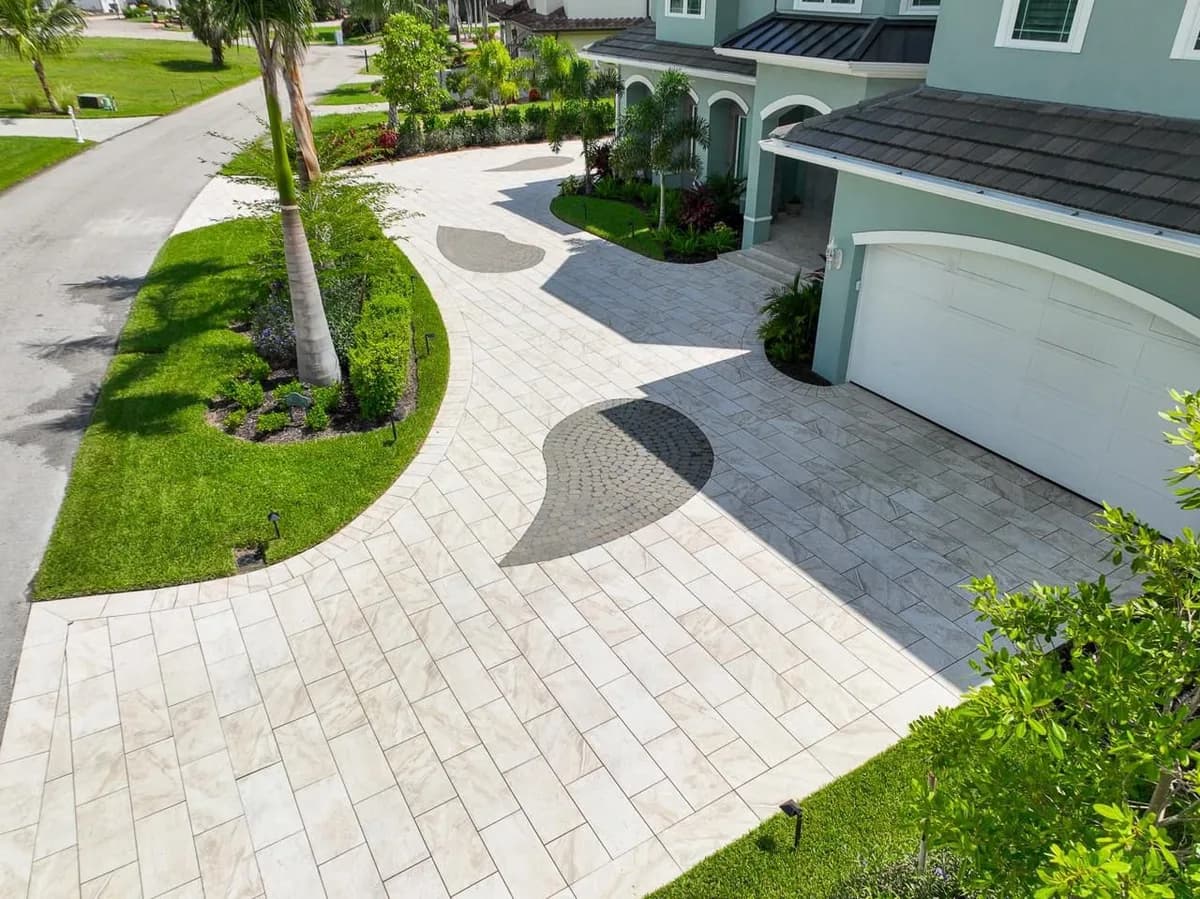
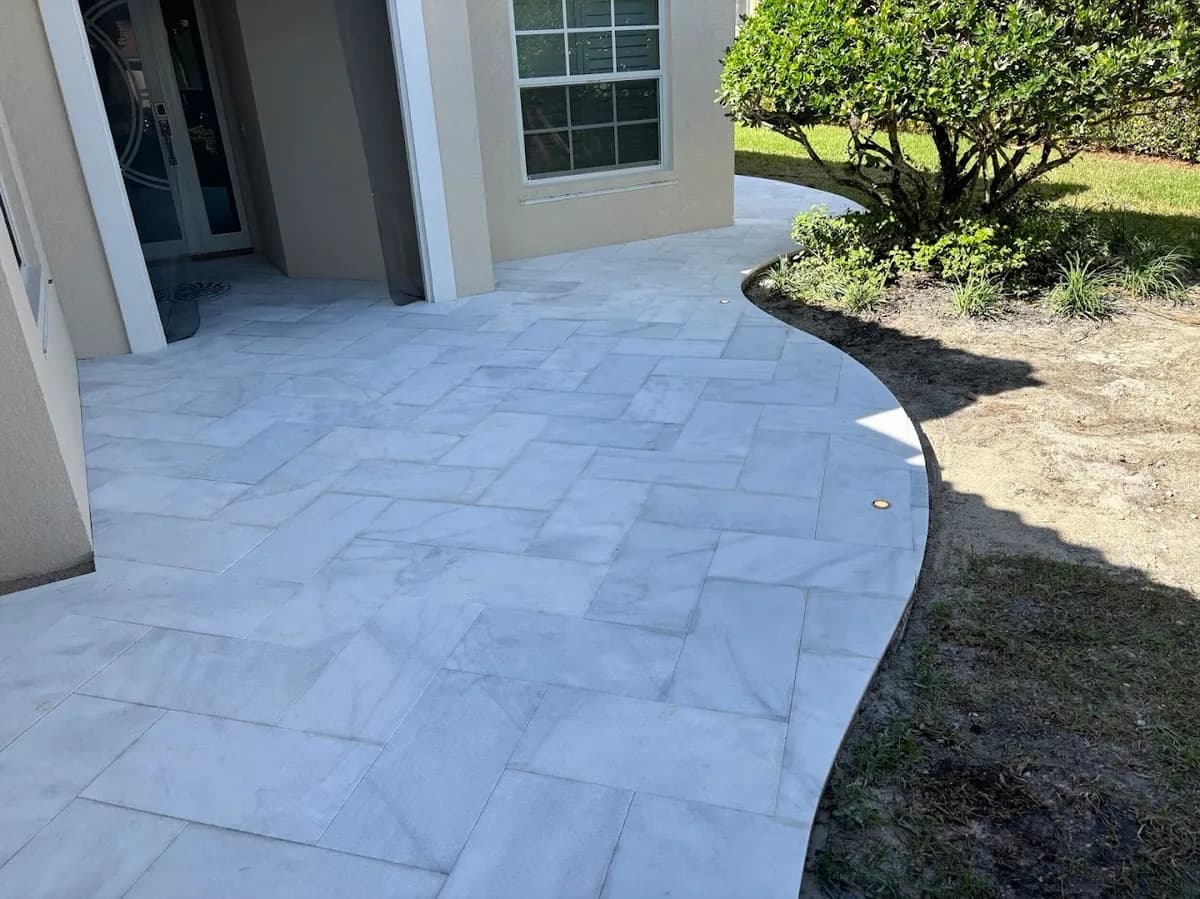
Yes, travertine can be used for a driveway in Florida, and plenty of them look wonderful in Lakewood Ranch and Palmer Ranch twenty years on: warm ivory and walnut tones, a soft tumbled edge, a surface that stays far kinder to bare feet in August than gray concrete. But when a travertine driveway fails, the stone itself is rarely the culprit. Travertine is a natural limestone with voids and veins, and every piece is a little different, so it does not carry load the way a uniform manufactured paver does. Whether it survives a decade of cars, delivery vans and lawn trailers depends on three things you control before the first piece is laid: the size and shape of each unit, the base underneath, and whether the stone is set on sand or bonded to a slab.
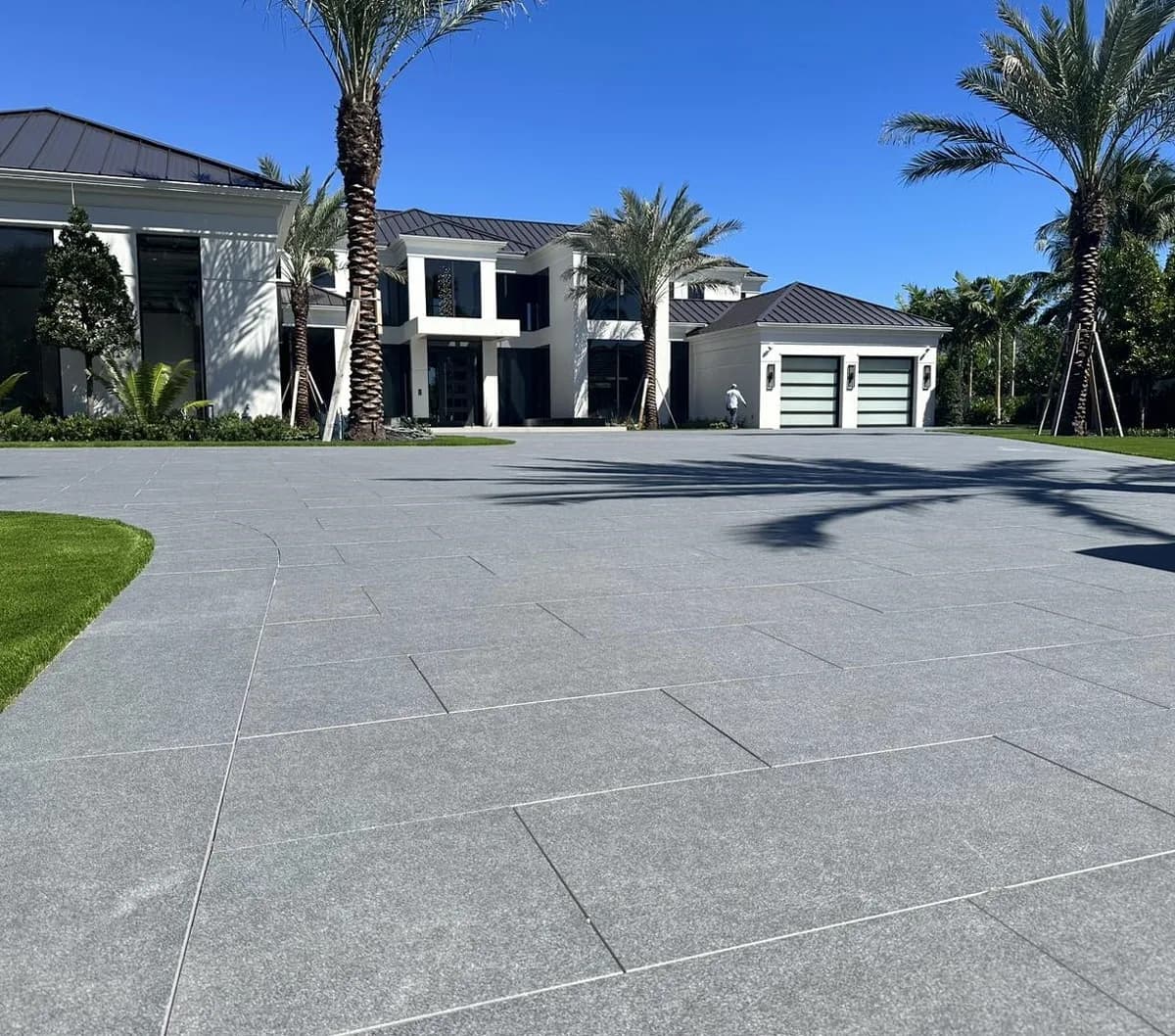
Format comes first. Travertine sellers commonly describe pavers around 1.25 inches thick, roughly 3cm, as the standard, and their own guidance steers driveways toward small rectangles such as 6x12 rather than large squares or the popular French pattern. The reasoning holds up in the field: a small paver has a short span, so when a tire rolls over it, the load spreads into the base instead of bending the stone. A 16x24 piece under the same wheel acts like a plank, and natural stone does not like bending. Treat any thickness or strength number as supplier guidance and confirm it on the spec sheet for the exact quarry and lot you are buying, because travertine density varies between sources. What we see is consistent: small formats on a solid base hold, big formats on a soft base crack.
Why Travertine Cracks Where Cars Turn
If a travertine driveway is going to crack, it usually starts in the same places: the turn in front of the garage, the spot where you swing the wheel to back out, and the apron where the driveway meets the street. Straight-line traffic is gentle. A tire turning in place is not, because it twists and drags each paver sideways while pressing down, and that scrubbing loosens joints and rocks the units against each other. Homeowners describe the pattern clearly: a sand-set travertine drive that looked perfect for two years, then cracked and loosened at the garage turn. In our part of Florida the base makes that worse. Much of Sarasota and Manatee sits on fine sand over a high water table, and after weeks of summer storms, an under-compacted base softens and lets pavers settle in the wheel paths.
There are two honest ways to build it. Sand-set travertine sits on a compacted aggregate base with bedding sand and a solid edge restraint; for a driveway we build that base about 8 inches deep over geotextile fabric, compacted in lifts, so the sandy subgrade cannot pump up into it. Its strength is flexibility: a paver that cracks can be lifted and replaced. Mortar-set travertine is bonded to a concrete slab, which locks the stones together and resists turning stress, but everything then depends on that slab. If the slab cracks, the crack telegraphs straight through the stone above it, and travertine suppliers themselves warn that rigid setting leaves the stone less room to move with heat. Mortar-set only works over a sound, properly jointed slab, with a flexible setting material and the slab joints carried through.
Rain, Sun, Oil and Mildew: Living With It in Florida
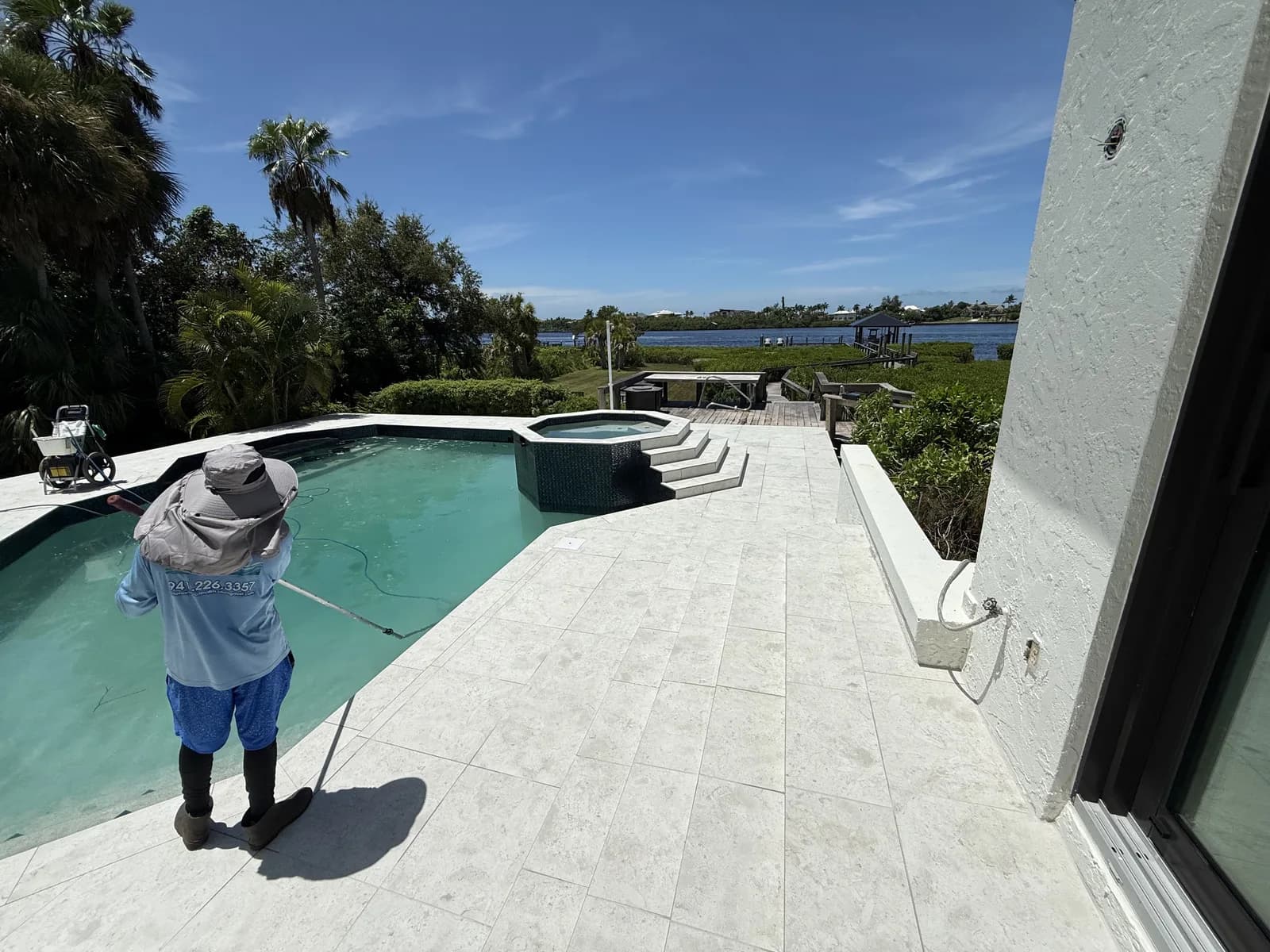
Florida is mostly kind to travertine. There is no freeze-thaw cycle to split water-filled pores, which is the main reason the stone has a rough reputation up north. Sun is the bigger player here: an unshaded driveway can swing around 40 degrees between dawn and mid-afternoon in July, and light-colored travertine absorbs less of that heat than dark concrete or asphalt, so it stays more comfortable to cross barefoot from the car to the pool. Rain is where the details matter. A summer downpour off a roof valley can dump a concentrated stream onto one corner of the drive, and on sand-set stone that stream washes joint sand out and undermines the edge. Gutters, downspout extensions and a slope of at least 1/8 inch per foot toward the street are part of a driveway that lasts, not extras.
The surface finish matters too. Unfilled travertine has open holes that collect sand, leaf grit and mildew spores, which is charming on a garden path and a nuisance under a car. Filled or honed travertine closes most of those voids and cleans up faster. On a driveway, sealing is not optional. Travertine is porous, so an oil drip, a leaking power steering line or hot tire plasticizer from a summer afternoon will soak in and stain if nothing is there to stop it. A breathable penetrating sealer, renewed every few years depending on traffic and sun, keeps those marks at the surface, where a degreaser can lift them. In shaded, north-facing driveways in Bradenton and around Anna Maria Island, expect a yearly cleaning to keep black mildew out of the pores and the color true.
Travertine, Porcelain or Concrete Pavers: Choosing for Your Drive
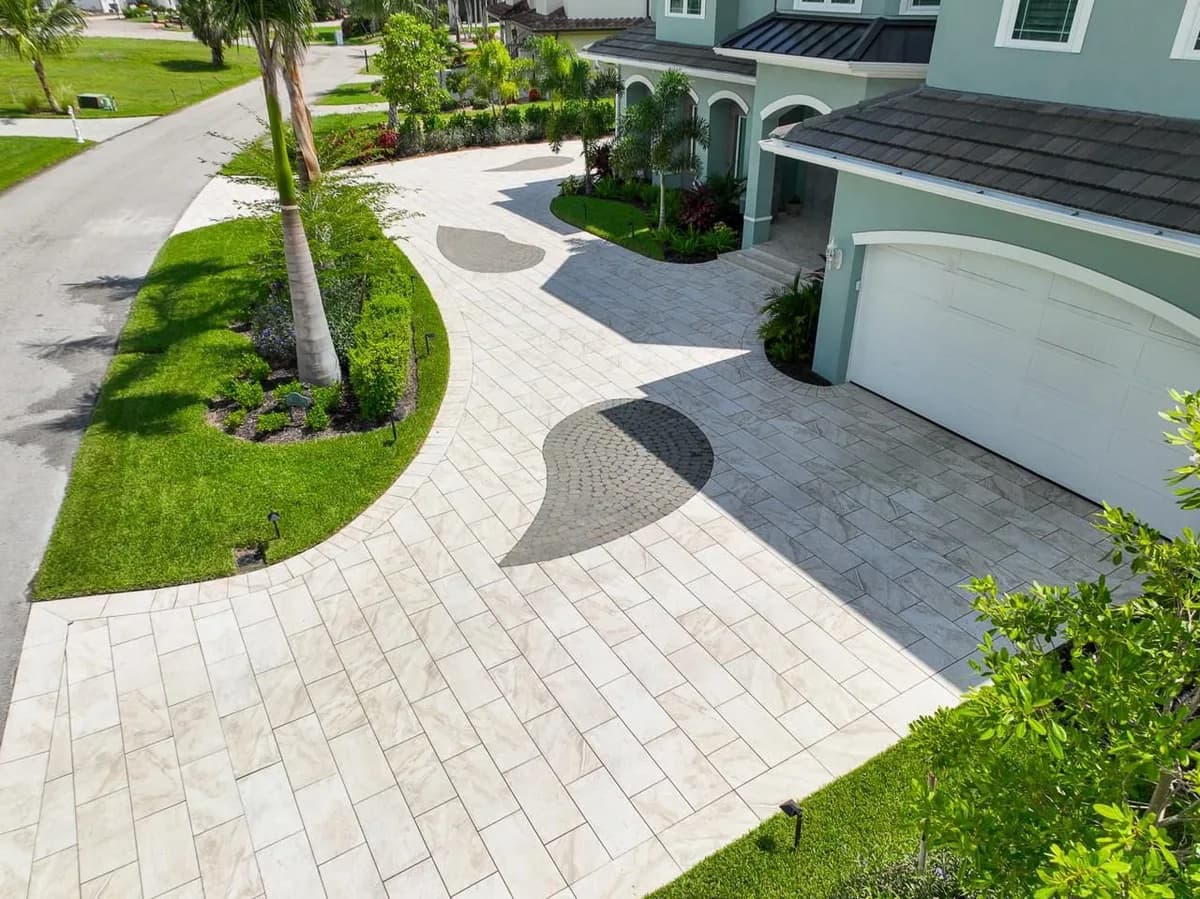
Here is how we lay out the choice on a site visit. Travertine wins on character: no two pieces match, it ages into a soft patina, and it suits Mediterranean and coastal homes in a way nothing manufactured fully imitates. It asks more of you in return: sealing, a careful format choice and a base that does not cut corners. Concrete pavers are the workhorse, built for vehicle traffic, easy to repair and usually the lower-cost option, though their color fades and they need sealing to keep it. Porcelain sits at the other end. A 3cm porcelain paver is vitrified, so oil and tire marks wipe off a surface that absorbs almost nothing, and travertine-look lines such as Belgard Travertini give you the stone appearance without the pores. For a driveway, manufacturers such as MSI call for mortar-setting porcelain over a concrete slab.
That is the honest trade-off: porcelain is the lowest-maintenance surface, but it depends on a sound slab beneath it; travertine is the most natural, but it depends on format and base; concrete pavers are the most forgiving and the plainest. HOA architectural boards in Lakewood Ranch and River Club often accept all three, but they review color, pattern and border details, so bring samples to the application rather than a brochure. At EC Paver Solutions, we install all three, and as the only Hardscape.com Certified porcelain paver installer in Sarasota, Manatee, Hillsborough, Orange and Lee Counties, we can tell you plainly when porcelain is the better fit and when your existing slab or your taste points elsewhere. The right answer comes from your soil, your slab, your roof lines and how you actually use the drive.
Travertine vs porcelain vs concrete pavers on a Florida driveway
| Material | Vehicle load | Heat underfoot | Stains & sealing | Look over time |
|---|---|---|---|---|
| Travertine (about 3cm, small format) | Good in 6x12-type formats on a solid base; large squares crack at turns | Light colors stay comfortable | Porous; seal every few years against oil, tire marks and mildew | Soft natural patina; every piece unique |
| Porcelain (3cm, mortar-set over slab) | Strong when bonded to a sound concrete slab | Depends on color; light tones stay cooler | Near-zero absorption; no sealing needed | Color stays like the sample; travertine-look lines available |
| Concrete pavers (sand-set) | Built for vehicles; easiest to repair | Darker colors run hot | Absorbs oil; sealing keeps color | Fades and dulls without sealing |
Every driveway is quoted after a site visit: slab condition, base, access and drainage change the scope more than the material does.
Financing Available
See your monthly payment before you decide
Compare real offers from more than twenty lenders through Acorn Finance, our financing partner. It takes about a minute, and checking does not affect your credit score.
Pay the way that suits you: credit and debit cards, bank transfer or check — or finance the project over monthly payments through our partner.
- Offers from 20+ lenders
- Pre-qualify in about 60 seconds
- No impact on your credit score

Financing is provided through Acorn Finance, an independent lending marketplace. EC Paver Solutions is not a lender and does not set rates or terms. Pre-qualification uses a soft credit inquiry and does not affect your credit score; final rates and terms come from the lender and are subject to approval.
Frequently Asked Questions
Can travertine be used for a driveway?+
How thick should travertine driveway pavers be?+
Should a travertine driveway be sand-set or mortar-set?+
Do you need to seal a travertine driveway in Florida?+
Is travertine or porcelain better for a driveway?+
Find Out What Your Driveway Can Carry
Book a site visit in Sarasota, Bradenton, Lakewood Ranch, Tampa, Orlando or Fort Myers. We will check your soil, slab, drainage and HOA requirements, bring travertine and porcelain samples, and leave you a written quote for the option that fits. Call (941) 250-4635 or book online.

Written by
EC Paver Solutions
EC Paver Solutions delivers premium paver installation across Sarasota, Bradenton, Lakewood Ranch, Tampa, Orlando, and Fort Myers. Hardscape.com Certified — the only certified hardscape contractor across five Florida counties.