

The 3 Reasons Paver Driveways Fail in Florida (And How We Build Them to Not)
A driveway that spreads, sinks or cracks within a few years failed for one of three reasons — and every one is preventable. Here is what actually goes wrong, and how a driveway is built to last.
The call: "the pavers are spreading"
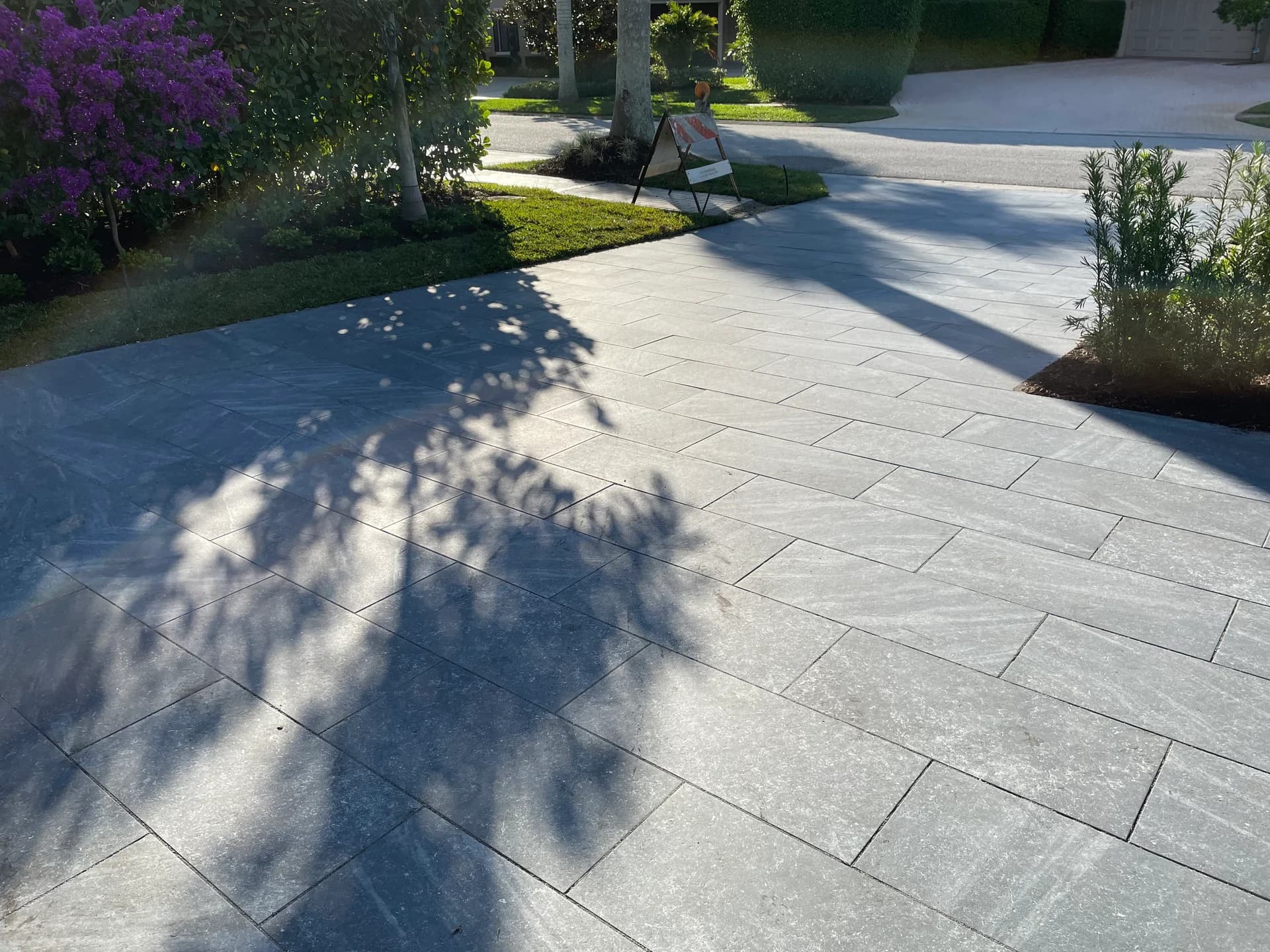
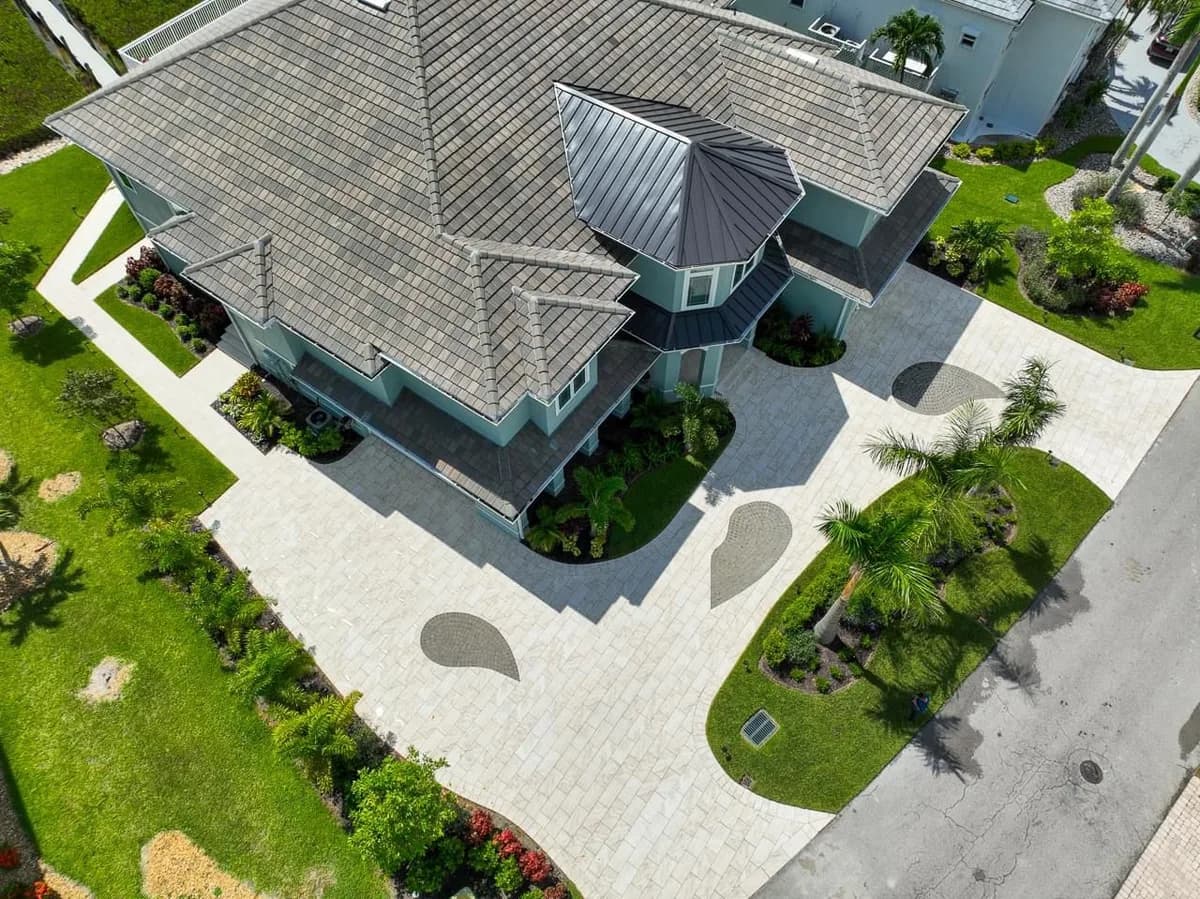
A homeowner calls: their paver driveway, installed by someone else about three years ago, is spreading at the edges, dipping in the tire tracks, and opening gaps between the pavers. They want to know if it can be fixed or has to be torn out. Nine times out of ten, the answer traces back to one of three things — and all three are decisions made before a single paver was laid. A paver driveway does not fail because pavers are a bad idea. It fails because it was built wrong for Florida.
Here are the three reasons, in the order we see them, and exactly how we build a driveway so none of them happen.
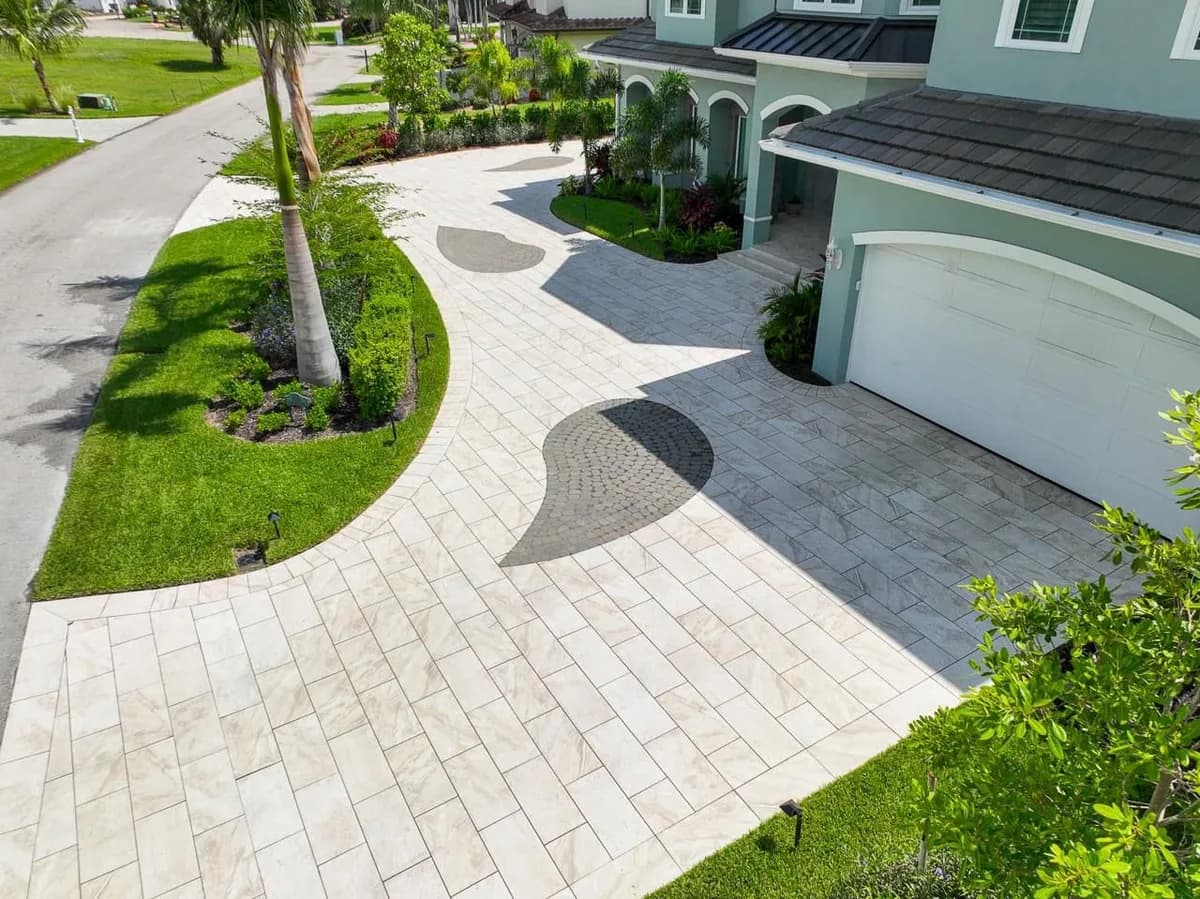
Reason 1: an inadequate base
This is the big one. A driveway carries thousands of pounds of vehicle, repeatedly, over Florida sandy soil — soil that shifts with rain and drains fast. Build the pavers on too little base, or a base that was never compacted properly, and the surface settles under the wheels. That is the dipping and rutting in the tire tracks.
A driveway is not a patio. We excavate deeper and build an 8-inch compacted crushed-limestone base, placed in lifts and compacted at every layer, over a geotextile fabric that keeps the soil and base from mixing. The base is the entire structural system; the pavers are the wear surface on top of it. Budget bids save money right here, because nobody sees the base — and it is exactly why those driveways fail first.
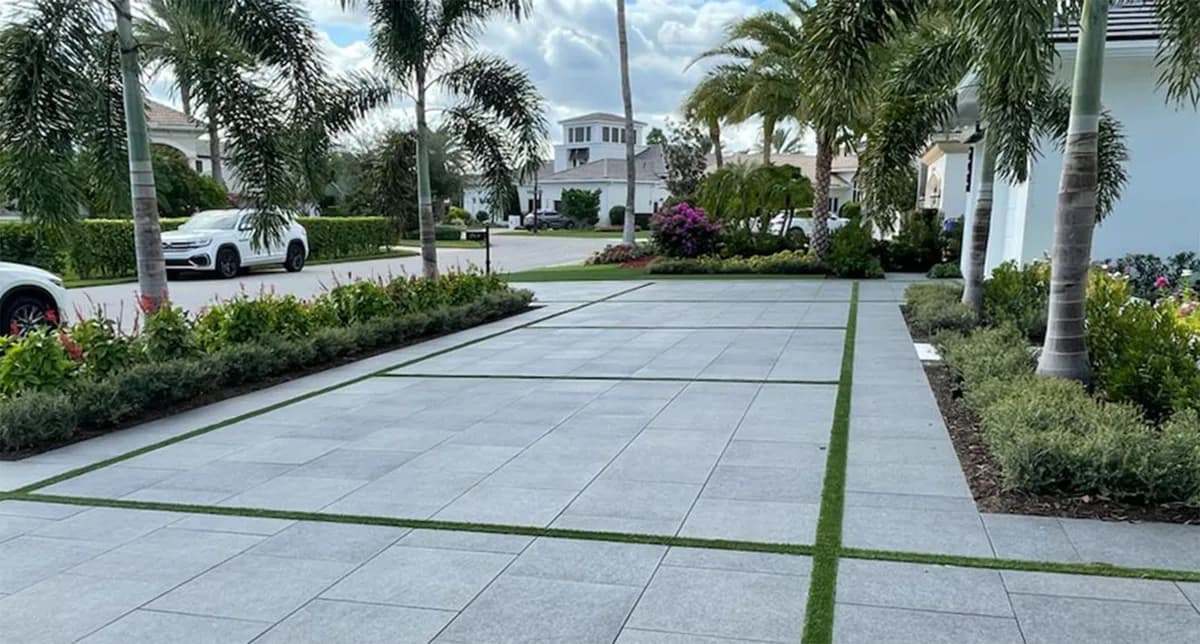
Reason 2: the wrong material or the wrong pattern
Two material mistakes sink driveways. The first is thickness. For porcelain, a driveway needs 3CM (1.25 inch) pavers — full stop. We see 2CM porcelain, which is a pool-deck and patio thickness, used on driveways to save cost; under repeated vehicle load it cracks from the edges inward within 12–18 months. Porcelain does not flex, and 2CM is simply too thin to carry a car.
The second is pattern. Herringbone at 45° is the engineering standard for driveways, and it is not a preference. When a tire rolls across pavers it creates a shear force pushing them apart; in a herringbone the interlocking V distributes that force across many pavers, and no joint runs parallel to the direction of travel. A running-bond pattern laid parallel to traffic concentrates that force on the joints and lets the pavers walk apart over time. We specify herringbone 45° on every vehicle driveway for exactly this reason.
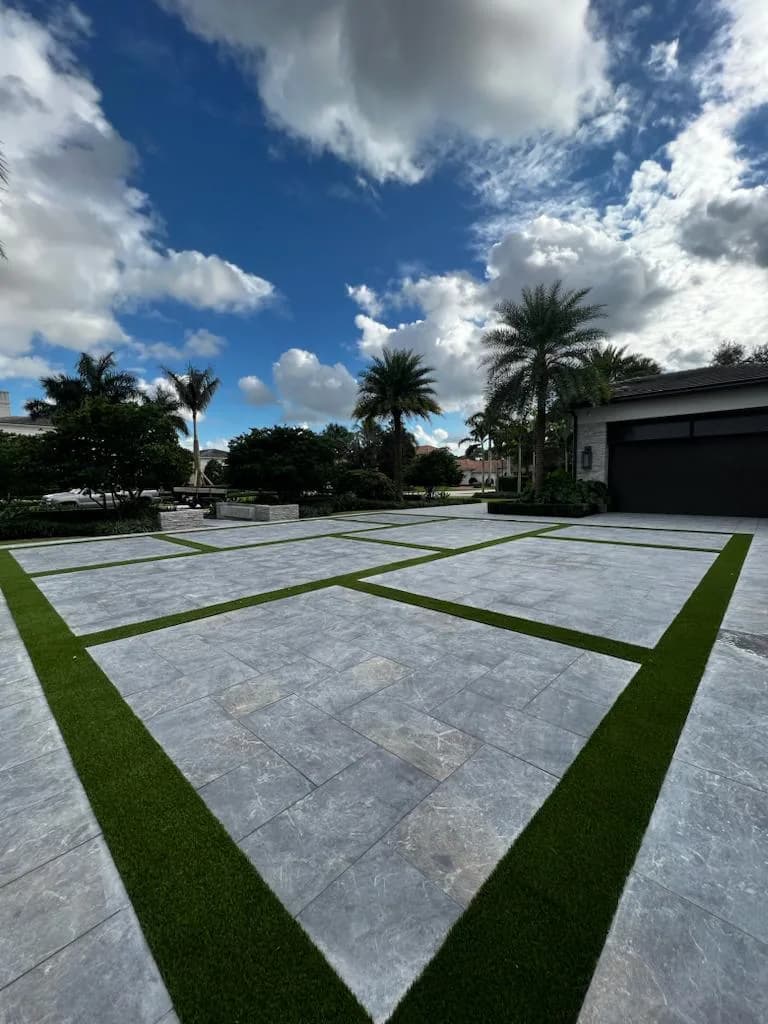
Reason 3: the edge restraint nobody sees
The third reason is the most invisible and, once you know it, the most obvious. Pavers on a driveway are held in place laterally by edge restraints along every perimeter and curve. Under thousands of vehicle passes, the whole field of pavers wants to creep outward. Without a properly installed, properly anchored edge restraint, the perimeter pavers migrate, the joints open, and the spreading starts at the edges and works inward — precisely the failure that generates the "my pavers are spreading" phone call.
We install concrete edge restraints or spiked restraints anchored every 12 inches around the entire driveway, in galvanized or stainless steel so they do not corrode in Florida salt air. It is a small line item that quietly holds the whole driveway together. Skipping it, or under-anchoring it, is one of the most common corner-cuts we get called in to repair.
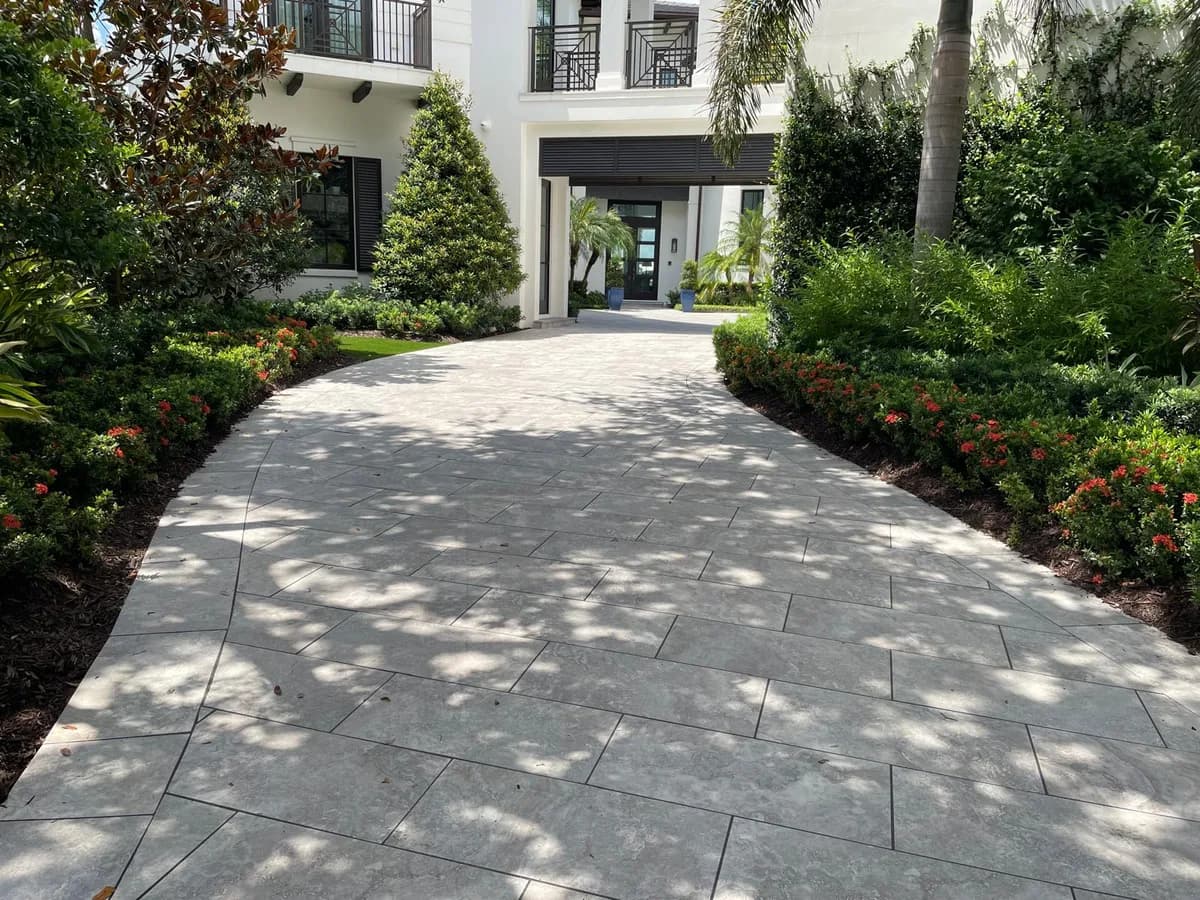
How we build one to last — and put it in writing
Put the three together and a driveway built not to fail is straightforward: an 8-inch compacted base over geotextile fabric; the correct material at the correct thickness — 3CM porcelain, or 2⅜-inch brick or concrete pavers — in a herringbone 45° pattern; edge restraints anchored every 12 inches in corrosion-resistant hardware; polymeric joint sand to lock the joints against Florida rain; and drainage slope built in.
The reason we can talk about all of this so specifically is that we specify every line of it in the written estimate — base depth, paver thickness, pattern, edge restraint, jointing. When you compare driveway quotes, that written spec is the whole game. If a quote is a few thousand dollars cheaper and does not say how deep the base is or how thick the paver is, you now know exactly where that money was saved — and what it will cost you in three years.
How a Florida driveway is built not to fail
| Element | The failure it prevents |
|---|---|
| 8" compacted base + geotextile | Settling and rutting in the tire tracks |
| 3CM porcelain (or 2⅜" brick/concrete) | Cracking under vehicle load |
| Herringbone 45° pattern | Pavers shifting apart under tire shear |
| Edge restraint anchored every 12" | Perimeter spreading and open joints |
| Polymeric joint sand | Joint washout and weeds in Florida rain |
| Written spec on every line | The corner-cut you cannot see in a cheap bid |
Installed driveway pricing in Sarasota and Bradenton spans a wide range, with 3CM porcelain sitting well above concrete or brick. Material sets the floor; base depth and edge work move the total far more.
Financing Available
See your monthly payment before you decide
Compare real offers from more than twenty lenders through Acorn Finance, our financing partner. It takes about a minute, and checking does not affect your credit score.
Pay the way that suits you: credit and debit cards, bank transfer or check — or finance the project over monthly payments through our partner.
- Offers from 20+ lenders
- Pre-qualify in about 60 seconds
- No impact on your credit score

Financing is provided through Acorn Finance, an independent lending marketplace. EC Paver Solutions is not a lender and does not set rates or terms. Pre-qualification uses a soft credit inquiry and does not affect your credit score; final rates and terms come from the lender and are subject to approval.
Frequently Asked Questions
How long should a paver driveway last in Florida?+
What is the best paver material for a Florida driveway?+
Do you need a permit for a paver driveway in Florida?+
How much does a paver driveway cost in Sarasota or Bradenton?+
Get a quote with written specs for every item.
Base depth, paver thickness, pattern, edge restraint, jointing — we specify all of it in writing, so you can compare quotes on what actually matters. Free on-site estimate across Sarasota and Bradenton.

Written by
EC Paver Solutions
EC Paver Solutions delivers premium paver installation across Sarasota, Bradenton, Lakewood Ranch, Tampa, Orlando, and Fort Myers. Hardscape.com Certified — the only certified hardscape contractor across five Florida counties.