

Hardscape.com CertifiedThe ONLYCertified Porcelain Paver Installer in Sarasota, Manatee, Hillsborough, Orange, Lee & Pasco Counties
(941) 250-4635
Signs of poor porcelain paver workmanship found on installations around Sanibel Island, Florida

Lee County

Pavers installed wrong in Sanibel Island?

What the defect is telling you, why it happened here, and what a correct installation required instead.

Why it goes wrong in Sanibel Island

Bad porcelain installations are not evenly distributed. They cluster around whatever kind of work dominates a market, because that is what sets the pace the crews work to. Around Sanibel Island, the concentration is in rebuild and restoration work across Fort Myers, Cape Coral and the islands — and in practice most of what we are asked to look at sits in Sanibel, Captiva, Gulf Pines, East Rocks and the streets around them.

Rebuild volume pulls in contractors faster than the region can vet them. Insurance timelines reward whoever starts soonest, and an outdoor porcelain deck is an easy thing to quote badly and a hard thing to undo.

The material is rarely at fault. At 2CM and 3CM porcelain is classified as tile, not as paver — no interlocking geometry, no load transfer to its neighbours, not enough mass to hold position. Installed the way a concrete paver patio is installed, it has nothing holding it. That single misclassification is behind most of what we are called out to look at in Lee County.

What we find most in Lee County

The two defects that show up first here

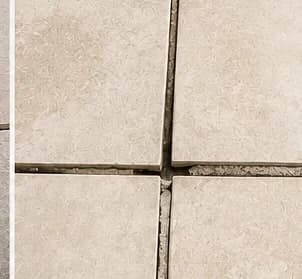
Misaligned porcelain pavers with one edge higher than the next, showing lippage Sign 1

Tiles that sit at different heights

Run a bare foot across the field and you catch an edge. In low sun the shadow line along each raised edge makes the whole surface look restless.

What went wrong

This is lippage, and on large-format porcelain it usually traces to two things: mortar that was not fully embedded under the tile, and a bond pattern with too much offset. Large tiles carry a slight crown, so a 50 percent offset lands the high centre of one tile against the low corner of its neighbour.

What it required

ANSI A137.1 allows 1/32 inch of lippage for joints between 1/16 and 1/4 inch. The TCNA recommends a maximum offset of about 33 percent for large-format tile — which is why a 30 percent running bond is the working standard on porcelain pavers, not the 50 percent brick pattern.
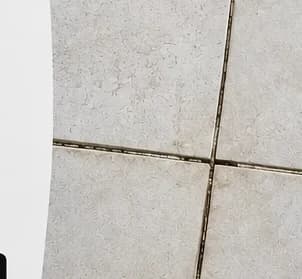
Porcelain pavers with inconsistent spacing and a joint closing to nothing Sign 2

Spacing that changes across the field

Some joints are tight to the point of touching, others are open. Where tile meets tile with no gap, the jointing material has nowhere to go.

What went wrong

Porcelain expands and contracts with temperature, and a joint that closes to nothing leaves the field no room to move. Under Florida sun a bonded deck can swing well over 30 degrees between dawn and mid-afternoon, and that movement has to go somewhere.

What it required

Consistent joints plus movement joints carried through the field and around the perimeter — at the house, at pool coping, at columns. A field bonded edge to edge with no relief is a field waiting to tent.

Seeing something else? There are six defects we look for, each with a photograph and the standard it broke — plus why there is no settled installation standard for outdoor porcelain in the first place.

All six signs

Sanibel Island questions

The material does not fail — the assembly does. In and around Sanibel Island the work that goes wrong is concentrated in rebuild and restoration work across Fort Myers, Cape Coral and the islands. Rebuild volume pulls in contractors faster than the region can vet them. Insurance timelines reward whoever starts soonest, and an outdoor porcelain deck is an easy thing to quote badly and a hard thing to undo. The result is the same handful of defects: voids under the tile, joints that drift, and water that has nowhere to go.

Yes, and it is a large part of what we do. We come out, sound the field for voids, check the slope against what a bonded porcelain deck actually requires, look at the joints and the perimeter detail, and give you a written assessment of what failed and why — including whether it needs a full rebuild or can be corrected in place. If it can wait, we say so.

Yes. Sanibel Island sits in Lee County, one of the six counties where EC Paver Solutions holds Hardscape.com certification. Assessment visits are free and there is no travel premium anywhere in our certified area.

Get it assessed in Sanibel Island

Free on-site visit, written findings, and a straight answer about whether it needs a rebuild or a repair. We are the only Hardscape.com certified installer in Lee County.

No obligation. We respond within 24 hours.

Five-year workmanship warranty · or call (941) 250-4635