

How Long Do Porcelain Pavers Last in Florida's Climate?
The porcelain itself will outlive your mortgage. What actually fails in Florida is almost always the installation underneath it.
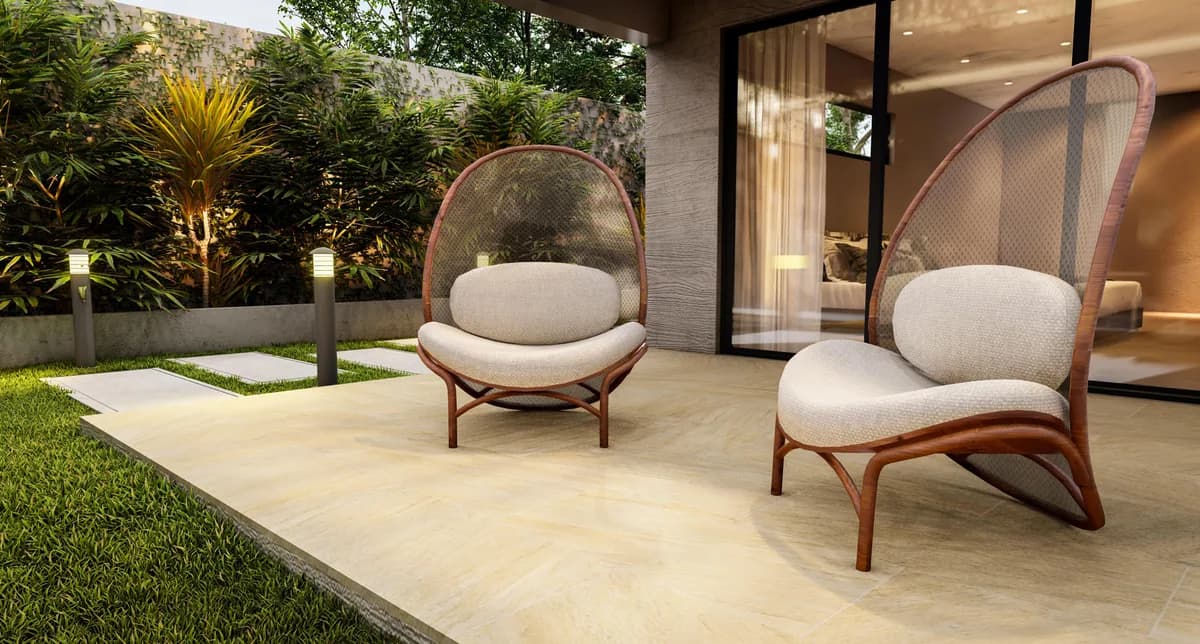
The Short Answer: The Material Basically Does Not Wear Out
I get this question on almost every porcelain estimate, and the honest answer surprises people: the paver itself is not really the thing that determines how long your patio or driveway lasts. Porcelain pavers are fired in a kiln at around 1200 degrees Celsius, which vitrifies the clay body into something denser and harder than granite. Water absorption on a quality porcelain paver runs under 0.5 percent, and the color runs all the way through the tile, not just a surface glaze. That combination is why manufacturers back these products with 30-year and even lifetime structural warranties — they are not being generous, they are describing a material that does not chalk, does not spall, and does not fade the way other pavers do.
When people ask how long do porcelain pavers last, what they usually mean is will this look the same in 15 years, and for the paver itself, yes. UV exposure that bleaches concrete pavers and travertine over a Florida summer has essentially nothing to react with in a through-body porcelain tile — there is no dye sitting on the surface to break down. Freeze-thaw is not a factor here, but even in climates where it is, porcelain near-zero porosity means there is no water getting into the tile to expand and crack it. On the material side alone, you are looking at a 50-plus-year product. The lifespan conversation only gets interesting once you ask what is underneath it.
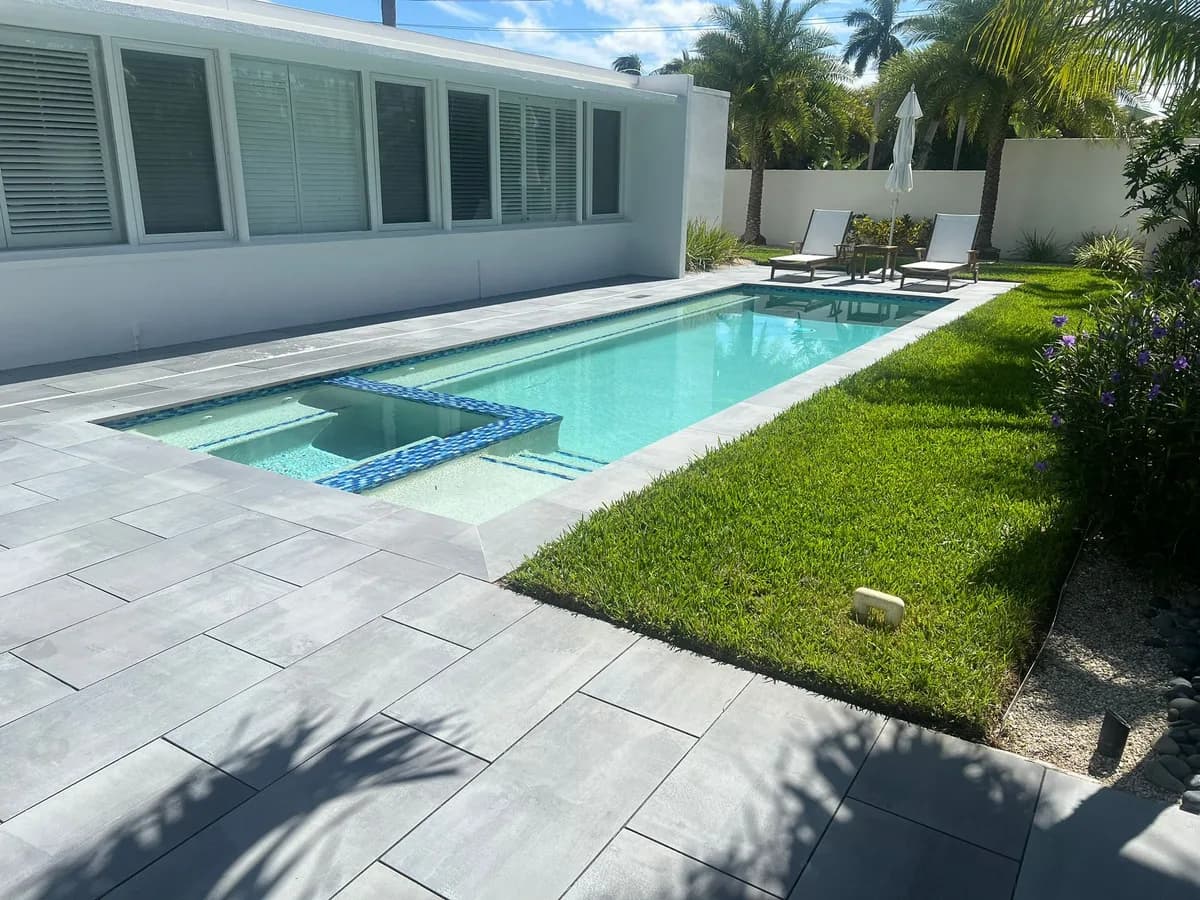
What Actually Fails: The Install, Not the Tile
Every porcelain failure I have ever been called out to repair traces back to the same handful of installation shortcuts, never the tile. Sarasota and Bradenton sit on sandy soil that compacts inconsistently and shifts with moisture, so base prep is not optional here the way it might be on denser clay soils up north. If a crew skips proper compaction of the aggregate base, or does not account for drainage slope away from the structure, you get settling. Settling under a rigid porcelain slab shows up as lippage, cracked corners, or pavers that rock underfoot — and none of that is the porcelain fault. It is a base that moved under it.
Thickness matters just as much. A 2CM porcelain paver is fine for a pool deck or patio where the load is foot traffic, but a driveway needs 3CM porcelain rated for vehicle weight, set on a base engineered to carry it. I have seen installers use thinner tile on a driveway to save on material cost, and it works for a year or two until a delivery truck or a heavy pickup cracks a corner. Joint work is the other variable: polymeric sand that is installed dry and never properly activated with water washes out in the first heavy Florida downpour, leaving gaps that let the base underneath erode. Get the base, the thickness, and the joints right, and there is genuinely nothing in this climate that touches the tile itself.
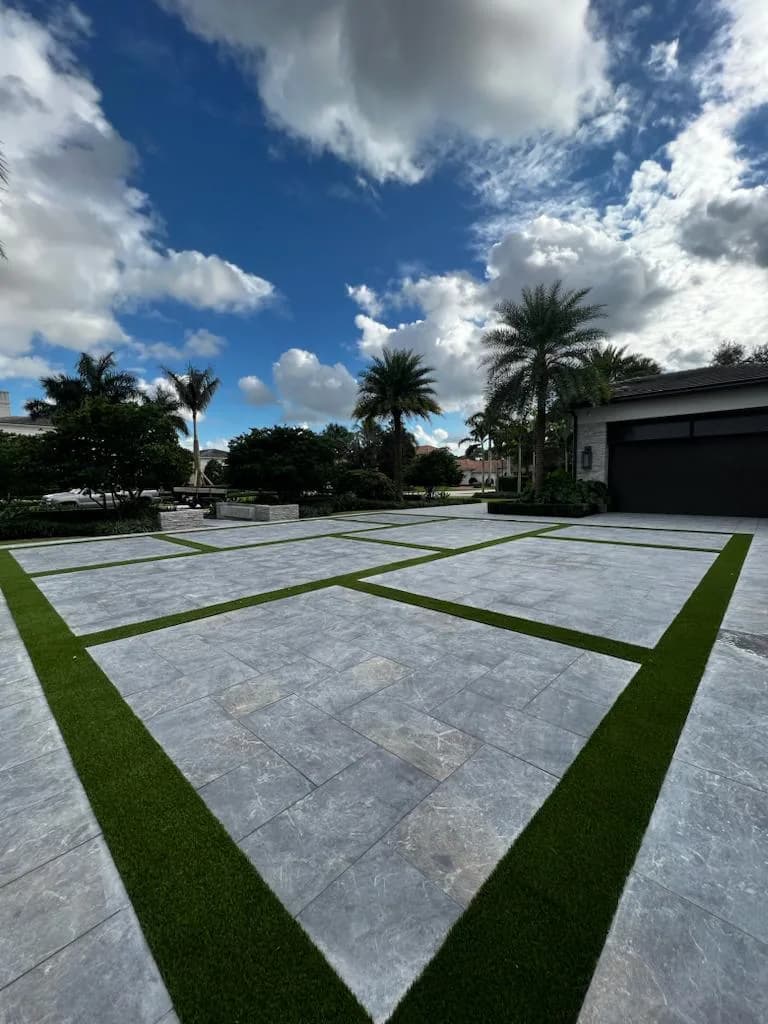
Florida's Climate Tests the Installer, Not the Material
It is worth walking through the specific things Florida throws at a hardscape, because every one of them is a non-issue for porcelain and a real issue for a bad install. UV is intense here nearly year-round, but with color running through the entire tile body, there is no pigment layer to bleach out — compare that to a stamped concrete paver, which relies on a surface coating that chalks and fades within five to ten years. Salt air along the coast corrodes metal and etches soft stone, but porcelain near-zero porosity means salt cannot penetrate it or crystallize inside the tile the way it does with limestone or unsealed travertine. Pool chemicals — chlorine splash-out, algaecides, acid washes — do not stain or etch porcelain the way they will natural stone that needs re-sealing every couple of years.
Heavy, sudden rain is probably the biggest real risk in this state, and it is squarely an installation issue rather than a material one. A properly built base with the right slope sheds water away from the structure; a base without adequate drainage holds water, which is what causes soil movement, washout under joints, and eventually settling. Sandy soil compounds this because it drains fast but also shifts fast if it is not stabilized correctly during prep. None of this is porcelain failing — it is water finding the one weak point in a build, which is always somewhere in the base, not in the tile sitting on top of it.
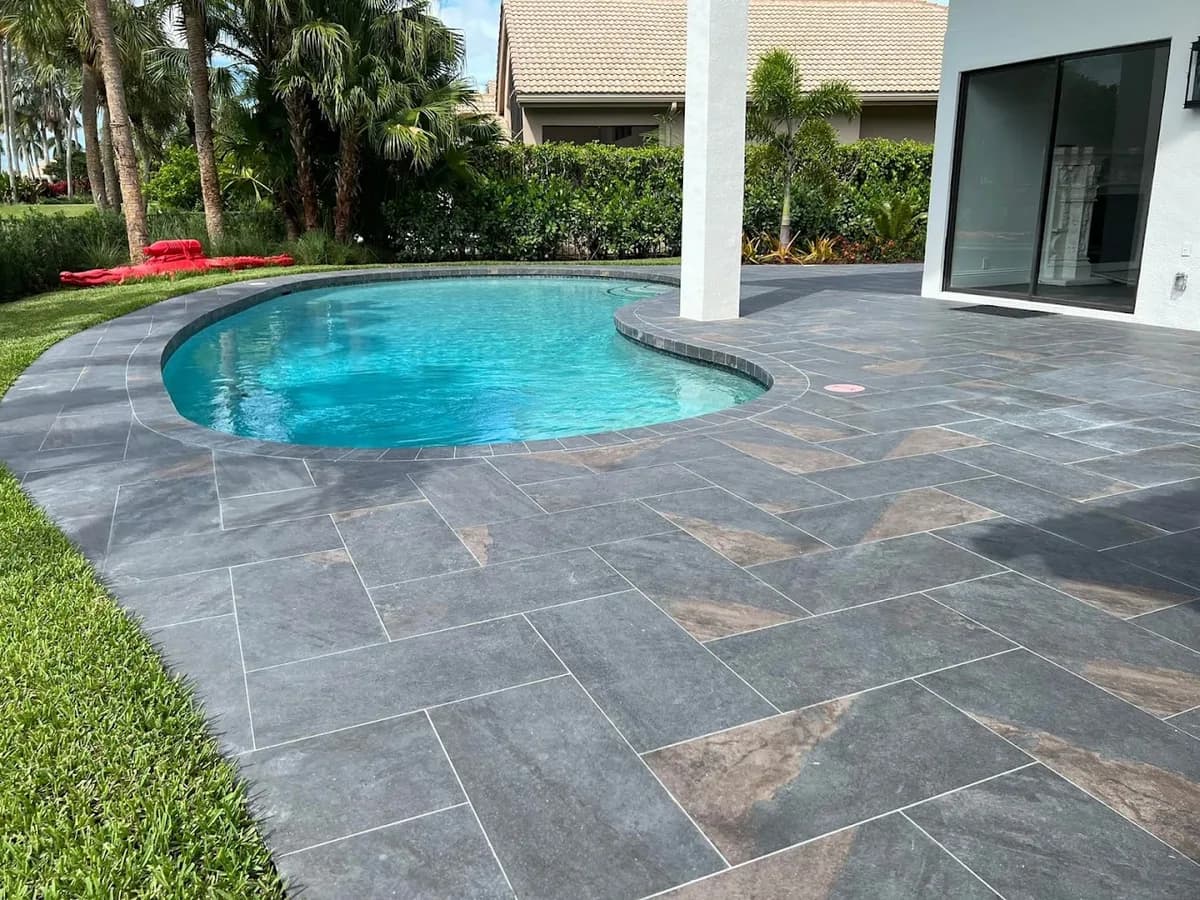
Porcelain vs the Alternatives, Over Time
It helps to see this next to what actually degrades in Florida. Concrete pavers are porous, so they absorb moisture, grow efflorescence (that chalky white bloom), and their surface color fades and spalls within roughly 10 to 15 years even with good maintenance. Travertine and other natural stone need periodic sealing to resist staining and etching from pool chemicals, and skipping that maintenance shortens their usable life considerably. Wood decking rots, splinters, and needs re-staining on a recurring schedule, which in humid coastal air can mean every year or two. Porcelain sidesteps all of it — no sealing, no staining, no efflorescence, because there is nothing porous or surface-coated for the climate to work on.
So when I tell a homeowner their porcelain patio or driveway is a 50-plus-year investment, I mean it, but I am also telling them that number is only as real as the base compaction, the drainage plan, and the joint work underneath it. That is the entire reason installation quality matters more with porcelain than with almost any other paver material — the tile has effectively no failure mode of its own, so every failure you will ever see traces back to what the crew did before the first tile ever went down. Hire for the install, not just the material spec sheet.
Financing Available
See your monthly payment before you decide
Compare real offers from more than twenty lenders through Acorn Finance, our financing partner. It takes about a minute, and checking does not affect your credit score.
Pay the way that suits you: credit and debit cards, bank transfer or check — or finance the project over monthly payments through our partner.
- Offers from 20+ lenders
- Pre-qualify in about 60 seconds
- No impact on your credit score

Financing is provided through Acorn Finance, an independent lending marketplace. EC Paver Solutions is not a lender and does not set rates or terms. Pre-qualification uses a soft credit inquiry and does not affect your credit score; final rates and terms come from the lender and are subject to approval.
Frequently Asked Questions
How long do porcelain pavers last?+
Do porcelain pavers fade in the sun?+
Do porcelain pavers crack in Florida?+
What makes porcelain pavers fail?+
Do porcelain pavers hold up to salt air and pool chemicals?+
Want an installation built to outlast the warranty?
Get a free on-site consultation and see exactly how we prep the base, set the thickness, and finish the joints so your porcelain hardscape holds up for decades in Florida climate.

Written by
EC Paver Solutions
EC Paver Solutions delivers premium paver installation across Sarasota, Bradenton, Lakewood Ranch, Tampa, Orlando, and Fort Myers. Hardscape.com Certified — the only certified hardscape contractor across five Florida counties.