

What Actually Goes Into a Resort-Grade Bradenton Pool Deck
A 450 sq ft porcelain pool deck in Bradenton, start to finish: the material decision, the base nobody sees, the coping detail that makes it, and an honest line-by-line breakdown.
It starts with a cracked slab and three confusing quotes
Most pool deck projects in Bradenton start the same way. A homeowner is tired of looking at a stained, cracked concrete deck that is too hot to walk on by mid-morning — and they have just collected three quotes that each recommend a different material at a different price. Concrete resurfacing from one, travertine from another, porcelain from the third. No two agree, and none of them explained why.
That is the real problem with pool deck shopping in Florida: the material is only half the decision, and it is the half everyone argues about. The other half — the base, the drainage, the grout, the coping — is where the money actually goes and where the deck actually succeeds or fails. This is a walk through one representative 450-square-foot porcelain deck: what we chose, why, how it goes in, and exactly what the investment covered.
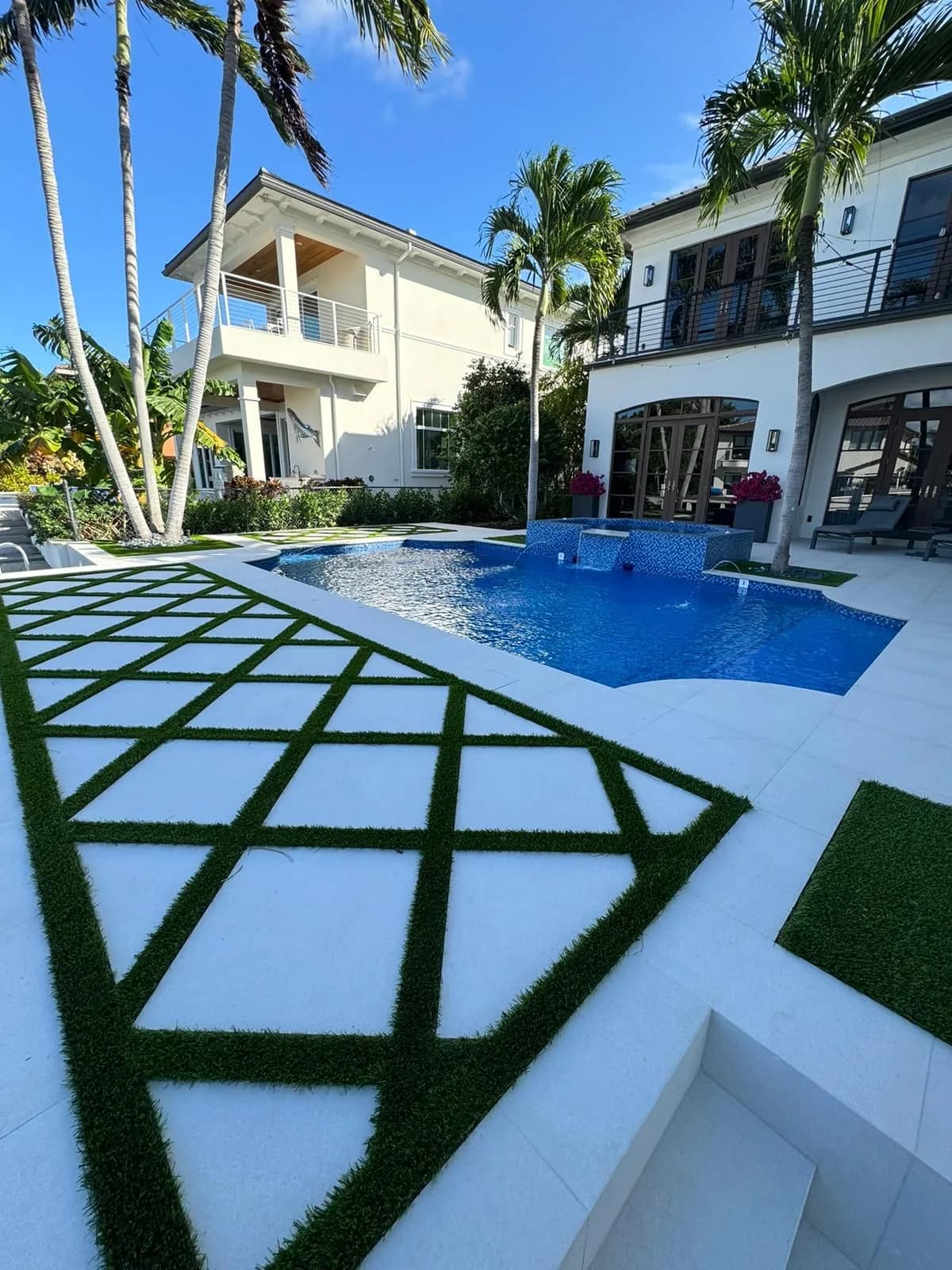
Why 2CM porcelain in ivory — and not travertine
Both porcelain and travertine make excellent Florida pool decks, and we install both. For this deck we recommended 2CM porcelain in an ivory tone for three specific reasons.
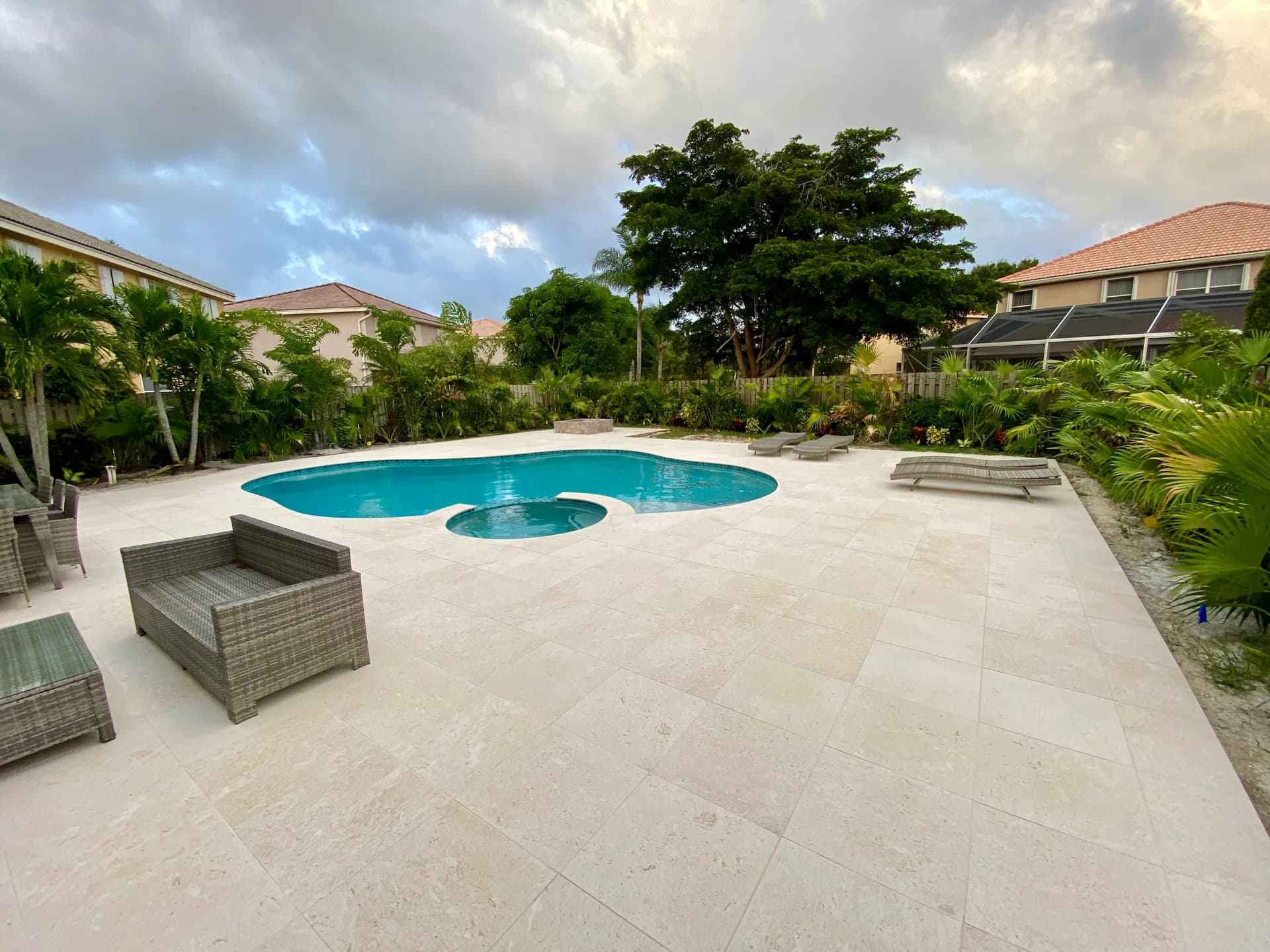
First, chemistry. This was a chlorinated pool with a salt system, and porcelain is non-porous — water absorption under 0.5%. Pool chemicals, sunscreen and salt bead on the surface and rinse off. Travertine is a porous natural stone; around a heavily used pool it needs resealing every two to three years to stay stain-free. The homeowner wanted no sealing required, and porcelain is the only material that honestly delivers it.
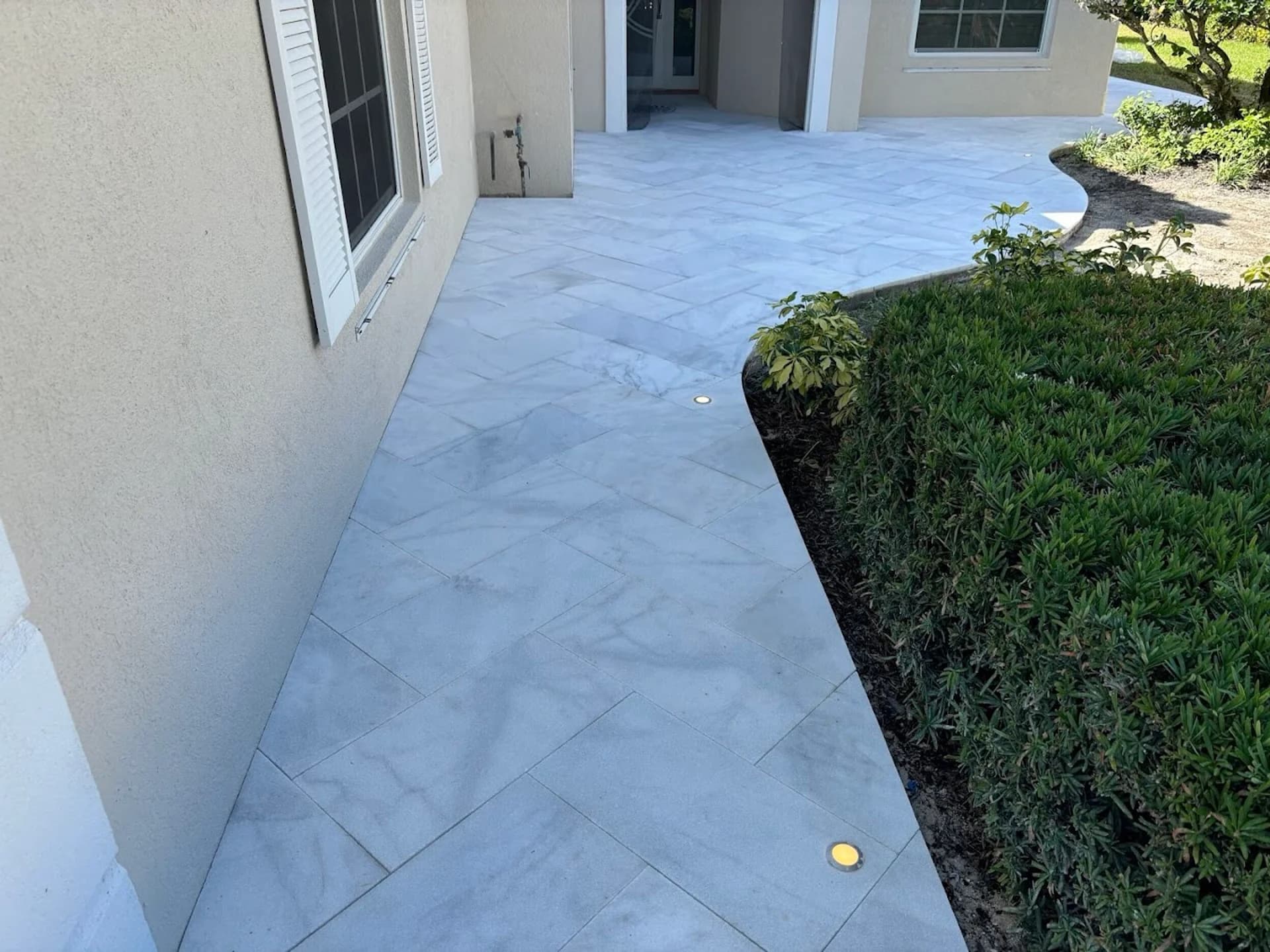
Second, heat. Ivory and light-grey porcelain reflect Florida sun and read 20–30°F cooler underfoot than dark concrete on an August afternoon. Color is the single biggest comfort decision on a pool deck, and we steer every client toward light tones for exactly this reason.
Third, slip. The porcelain we specify for pool decks carries an R11 slip rating and a DCOF above 0.60 — the wet-surface standards that matter around water. We never use polished or indoor tile outdoors, and we never use unfilled travertine at a pool, because the open voids collect algae in Florida humidity. Those are the two mistakes we get called to fix most often.
The part you never see — and the part that lasts
Here is the section no brochure photographs and no low bid wants to talk about. Underneath a resort-grade deck is a base most homeowners never see and never think about — until it fails.
Florida sandy, high-water-table soil moves. It shifts with rain and drains fast, and a deck built directly on it will settle and separate within a season or two. So before any porcelain is set, the area is excavated, lined with geotextile fabric to keep soil and base from mixing, and built back up with a compacted crushed-limestone base placed in lifts and compacted at every layer. Drainage slope is set away from the pool and the house at a minimum of an eighth-inch per foot.
For decks going over an existing sound slab — common on Bradenton lanais and older pool cages — the approach changes: the porcelain is mortar-set directly onto the cleaned, profiled concrete, which is extremely stable and skips demolition entirely. We assess every existing slab before recommending it; not all of them qualify.
When a deck shifts, cracks at the joints, or grows a low spot that holds water, the base was the cause about nine times out of ten. It is invisible, it is unglamorous, and it is the whole game.
Setting the deck: grout, coping, and the details that read as “resort”
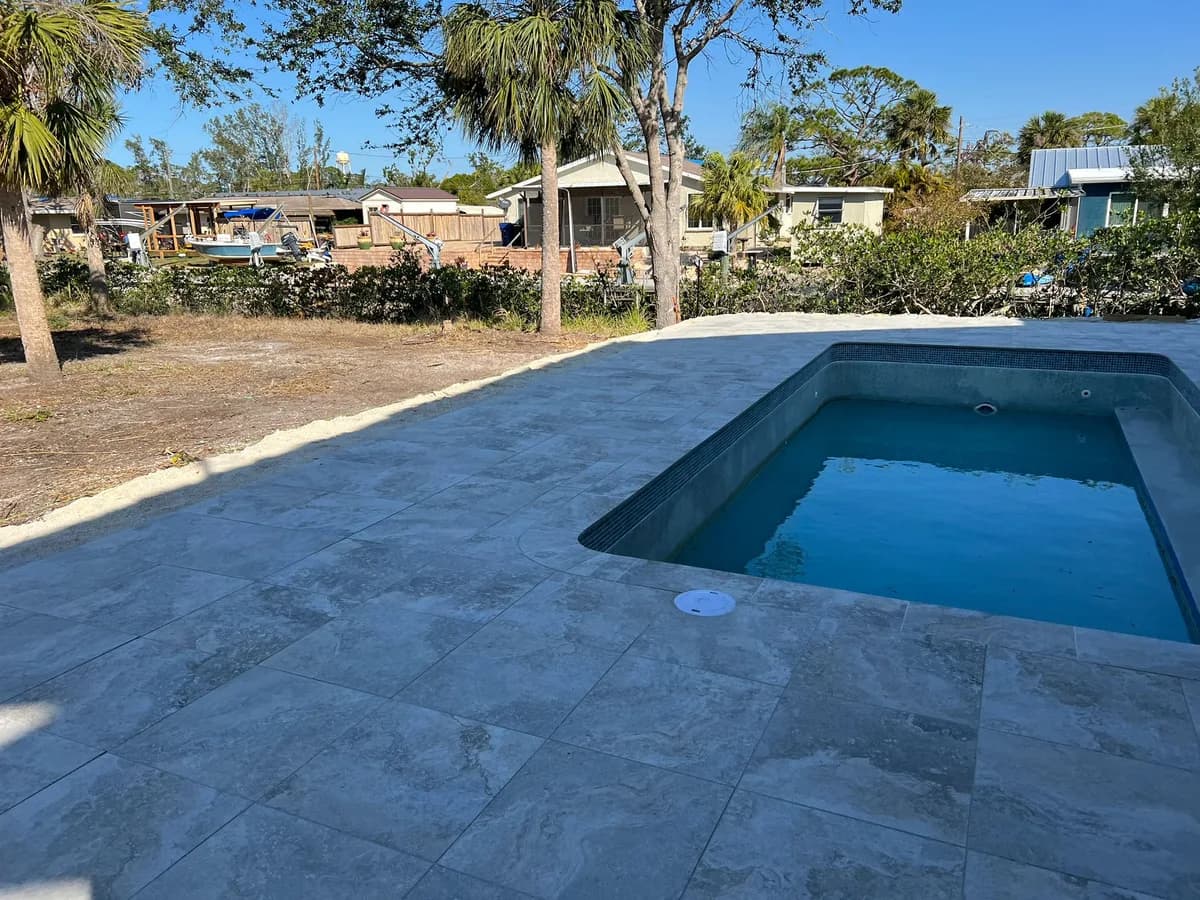
With the base graded, the porcelain is set to the pattern, leveled continuously, and cut precisely at the pool edge, the screen track and any drains. Around water we grout with epoxy rather than standard cement grout — it is non-porous, resists pool chemistry and salt air, and does not crumble at the joints over time. On coastal and salt-system decks this is not optional.
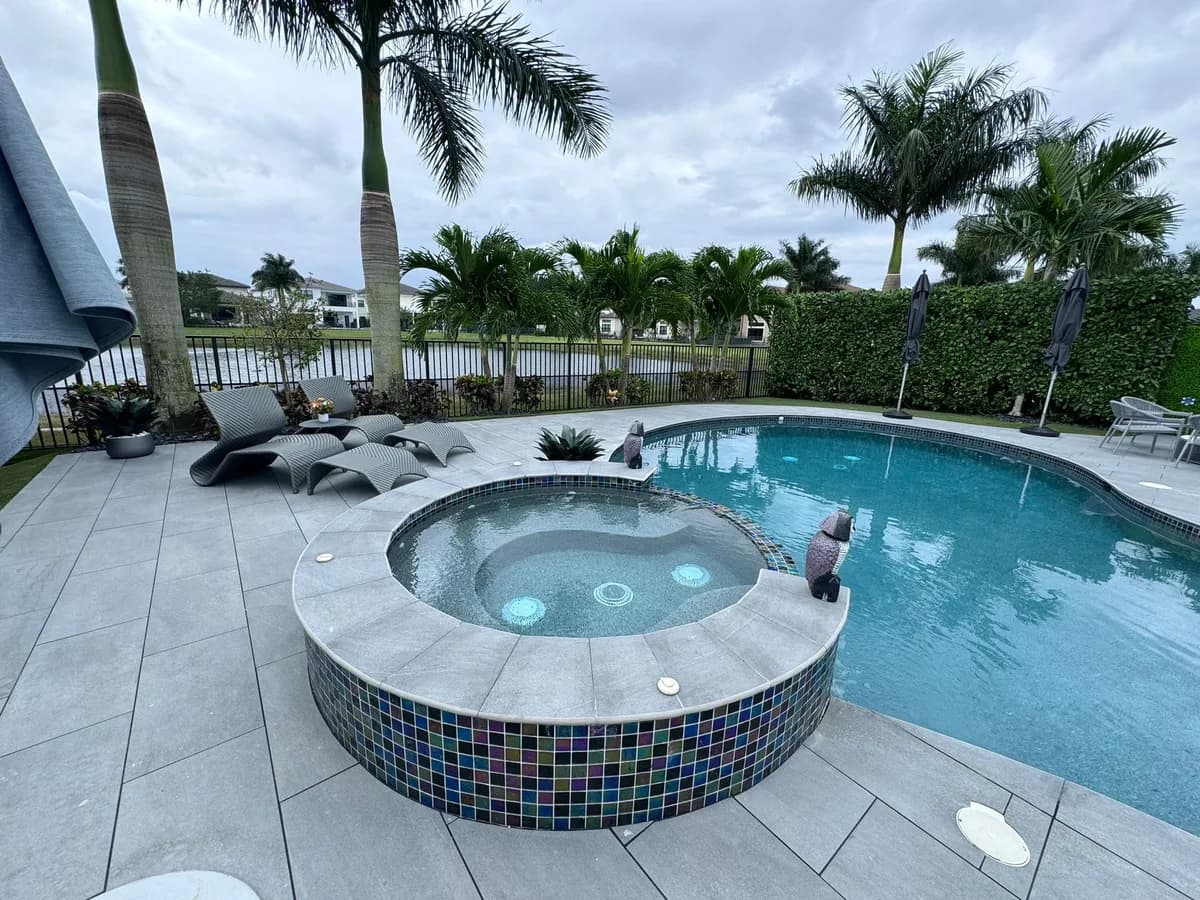
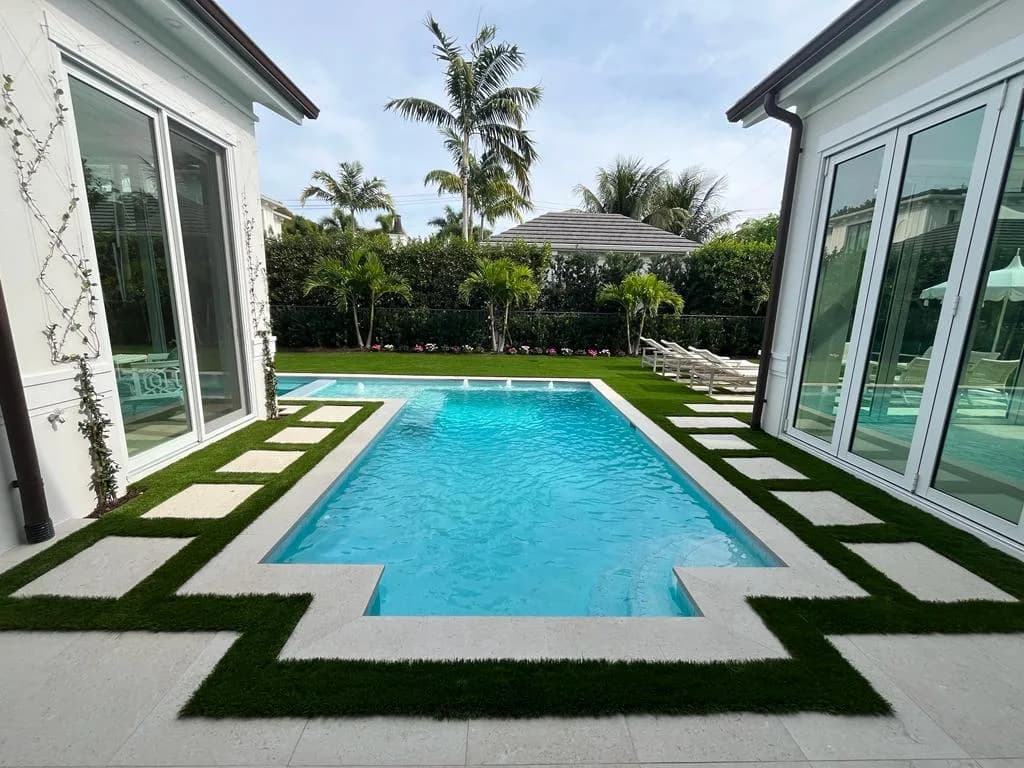
The detail that quietly does the most work is the coping — the cap where the deck meets the pool. Coping is bonded to the pool bond beam, not just butted against the deck pavers, and it gets its own profile, usually a bullnose or drop-face. Done right, it is the line your eye reads as “resort.” Skipped or improvised, it is the line that reads as “tile job.” We detail coping first, not last.
The deck is finished with a sweep of the joints, a rinse, and a walkthrough. Porcelain needs no sealer — that is the entire maintenance program.
The result — and the honest breakdown
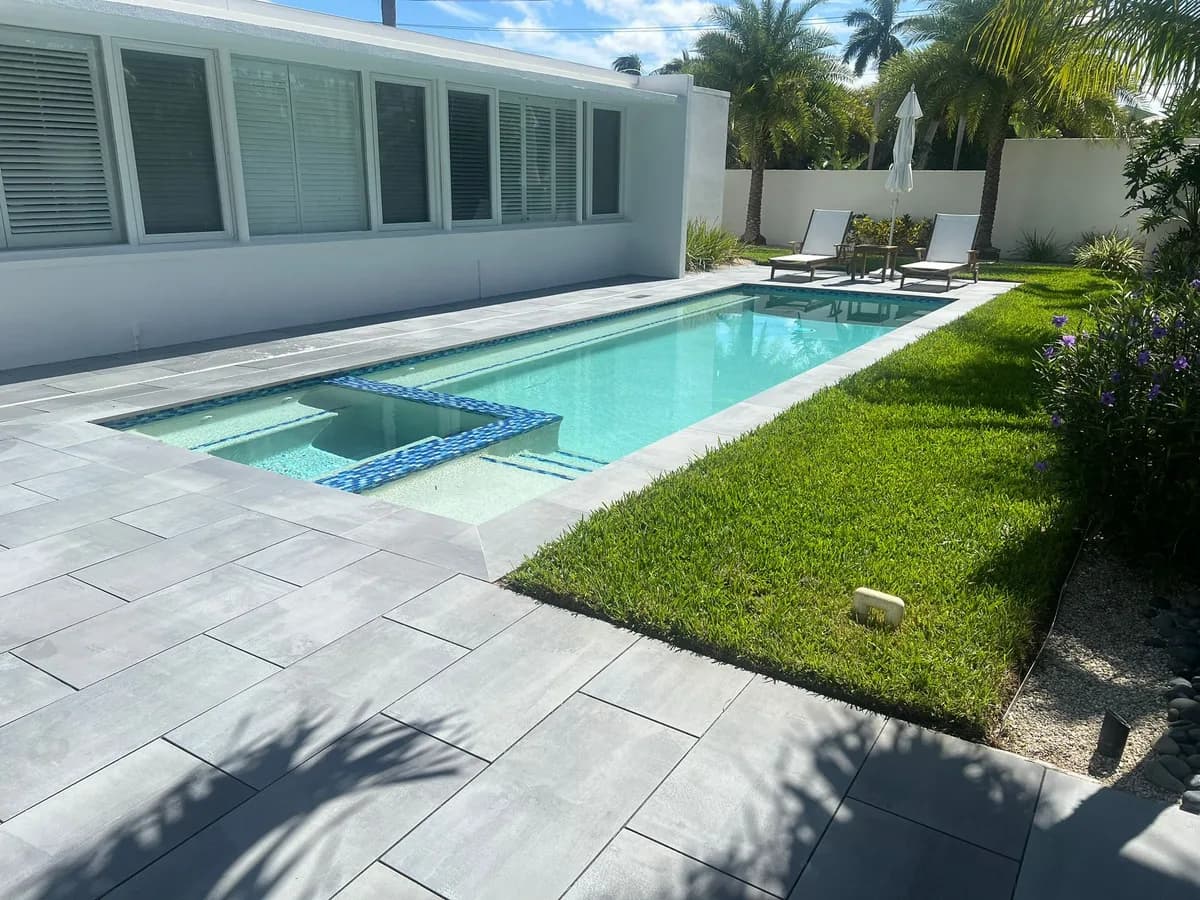
The finished 450-square-foot deck reads exactly like the goal: clean, bright, cool underfoot, and effectively sealing-free. No sealing schedule, no staining from sunscreen or leaves, no fading in the sun. In photos — which matters more than ever for anyone who rents the property — it reads as a resort surface, not a patio.
A project like this is a serious investment fully installed. That surprises people until they see what is inside it, so here it is in full.
What a 450 sq ft porcelain pool deck actually includes
| Line item | What it includes |
|---|---|
| 2CM porcelain (ivory, R11) | Hardscape.com certified product, light heat-reflective tone |
| Excavation & base | Geotextile fabric + compacted crushed-limestone base in lifts |
| Drainage & grading | Slope set away from pool and house, min ⅛" per foot |
| Coping | Bonded to the pool bond beam, bullnose or drop-face profile |
| Epoxy grout | Non-porous — pool-chemistry and salt-air resistant |
| Cutting & edge work | Precise cuts at pool edge, screen track and drains |
| Labor & finish | Certified crew, joint sweep, final walkthrough |
Statewide, a porcelain pool deck prices according to product, access and coping detail. We itemize every line in writing on the estimate.
Financing Available
See your monthly payment before you decide
Compare real offers from more than twenty lenders through Acorn Finance, our financing partner. It takes about a minute, and checking does not affect your credit score.
Pay the way that suits you: credit and debit cards, bank transfer or check — or finance the project over monthly payments through our partner.
- Offers from 20+ lenders
- Pre-qualify in about 60 seconds
- No impact on your credit score

Financing is provided through Acorn Finance, an independent lending marketplace. EC Paver Solutions is not a lender and does not set rates or terms. Pre-qualification uses a soft credit inquiry and does not affect your credit score; final rates and terms come from the lender and are subject to approval.
Frequently Asked Questions
How much does a porcelain pool deck cost in Bradenton?+
Is porcelain or travertine better for a Florida pool deck?+
Do porcelain pool decks get hot in Florida?+
Can you install a pool deck over my existing concrete?+
Comparing pool deck quotes for a Sarasota or Bradenton property?
We visit on-site, bring material samples, and give you a written estimate with every line specified — product, base depth, coping and grout. No surprises.

Written by
EC Paver Solutions
EC Paver Solutions delivers premium paver installation across Sarasota, Bradenton, Lakewood Ranch, Tampa, Orlando, and Fort Myers. Hardscape.com Certified — the only certified hardscape contractor across five Florida counties.